
CALCIUM PARTNER PROGRAM
More Value for Your Clients. More Opportunities for Your Business.
Expand what you can offer healthcare organizations without building every solution yourself.
Calcium offers complementary digital health capabilities that can help your customers connect information, guide patients between visits, and support care teams.
Explore a partnership that creates added client value, strengthens your existing business relationships, and opens new commercial opportunities for your organization.
WHY PARTNER WITH CALCIUM
Grow Your Business by Delivering More to Clients.
A commercially practical way to extend your value in healthcare.
Healthcare vendors grow when they solve meaningful problems for customers and maintain relationships those customers want to keep. Yet building every requested feature or creating every new service can pull resources away from your core strengths.
A Calcium referral partnership lets qualified vendors introduce a complementary platform when it genuinely fits a client’s needs. The opportunity is not merely to earn a commission; it is to become more useful to healthcare organizations you already serve.

Open Revenue Opportunities
Introduce qualified healthcare clients to Calcium when a need arises. Approved referrals can create incremental income for your business, with defined eligibility, attribution, and payment terms established through a written partnership agreement.

Deepen Client Relationships
Show customers that your company understands challenges extending beyond its original product. Recommending a relevant complementary solution can reinforce your trusted adviser role, support better conversations, and create reasons to stay engaged.

Expand Solution Capabilities
Address more client needs through access to Calcium’s connected health information, clinician directed pathways, and patient engagement capabilities. Your organization can broaden the options it recommends without funding equivalent development or delivery.

Simplify Partner Selling
You identify a potential fit and connect the customer with Calcium. Under the standard referral model, our team manages demonstrations, evaluation, contracting, and platform delivery, keeping your sales and account teams focused.
THE HEALTHCARE VENDOR CHALLENGE
Your Clients Need More. You Cannot Build Everything
Customer expectations keep expanding while vendor resources remain finite.
Healthcare organizations face rising demands for more connected information, personalized patient engagement, efficient follow-up, and better experiences beyond the exam room. Vendors serving those organizations hear about the gaps firsthand, but solving each request internally is rarely realistic. New product development consumes engineering time, additional services require staffing, and introducing another vendor can feel risky.
The right complementary partnership can turn these competing pressures into an opportunity to deliver greater value without losing focus.

Rising Client Expectations
Healthcare providers increasingly ask vendors to help solve challenges beyond one application or service. Customers want practical ways to connect data, support patients, and coordinate work, even when those capabilities fall outside existing offerings.

Growing Competitive Pressure
Similar products often compete for the same healthcare budgets, putting pressure on price and feature differentiation. Vendors need credible ways to demonstrate added relevance and solve customer problems without promising a complete replacement platform.

Limited Development Capacity
Engineering budgets, implementation teams, and support staff cannot expand every time a client identifies another problem. Even valuable features may require extensive development, testing, integration work, and ongoing maintenance before they deliver customer value.

Protecting Client Trust
Recommending a third party puts the vendor’s reputation at stake. Partners need transparent product boundaries, trustworthy sales practices, realistic implementation commitments, and responsive support before they feel comfortable introducing another company to important customers.
A COMPLEMENTARY APPROACH
Bring More Solutions to the Relationships You Have Built
Your expertise plus Calcium’s capabilities can create a stronger client experience.
A productive technology partnership should start with customer fit, not with a referral quota. Your company understands the providers it serves, the systems they use, and the demands on their teams.
Calcium brings additional capabilities for supported clinical and patient generated information, digital pathways, and ongoing engagement. Where those capabilities complement your own offering, we can work together to explore a practical solution and preserve clear responsibilities for the customer relationship.


Your Market Expertise
You know your healthcare clients, their business priorities, and the problems they encounter in daily practice. That understanding helps identify appropriate opportunities without promoting software that does not match a real customer need.

Calcium Digital Capabilities
Calcium brings provider dashboards, a patient health app, and tools for creating guided Digital Pathways. These capabilities can support relevant client use cases when data access, clinical ownership, and technical requirements are confirmed.

More Client Options
Healthcare organizations gain another way to address unmet digital health needs while retaining the systems and vendor relationships that already serve them. Actual workflows, responsibilities, and implementation requirements are evaluated for each customer.
ONE CONNECTED DIGITAL HEALTH PLATFORM
Give Your Clients More Ways to Connect Care
Three complementary platform components make diverse partnership opportunities possible.
The Calcium Digital Health Platform supports healthcare professionals and their patients through a connected set of tools. Providers can review available information and organize appropriate follow-up; clinical teams can develop clinician reviewed Digital Pathways; and patients can participate through an accessible mobile app.
These capabilities can help address needs that arise beyond a partner’s main software or service. The fit of any proposed use case depends on supported integrations, organizational workflows, and customer requirements.
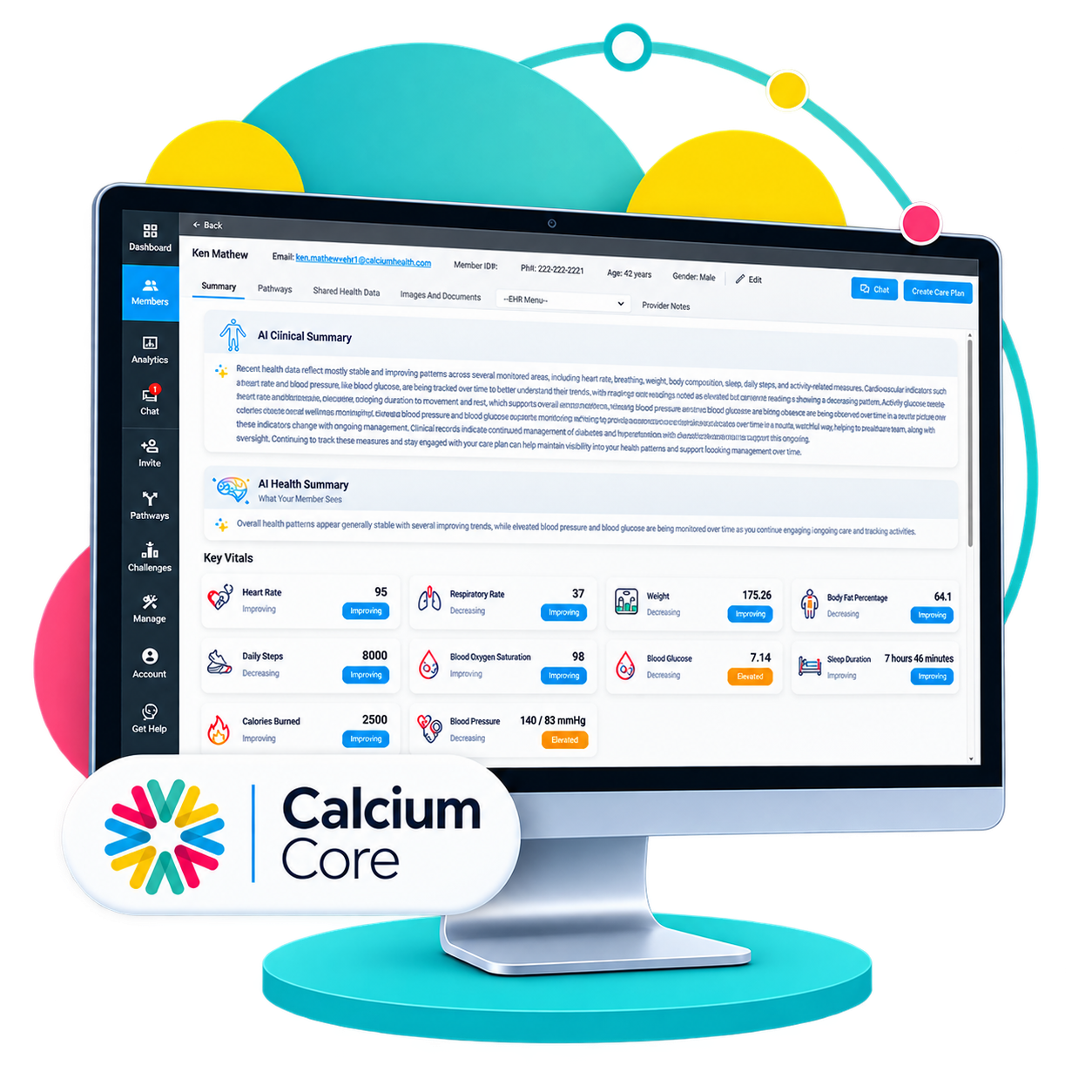
Calcium Core
360° Patient Insights
Calcium Core provides a provider facing environment for available clinical information, shared patient data, Digital Pathway activity, supported device measurements, and configured alerts. It helps teams review relevant information and organize follow-up under their own clinical rules. For partners, Core can be relevant when clients seek more visibility beyond isolated systems or encounters.

Calcium AI Studio
Let Clients Leverage Their Expertise
Calcium AI Studio helps organizations create, configure, and manage Digital Pathways built around their programs and protocols. Teams can include education, questions, reminders, and care activities, with responsible clinicians reviewing content before use. For partners, AI Studio may complement existing offerings when customers want structured, personalized engagement between appointments and other encounters.
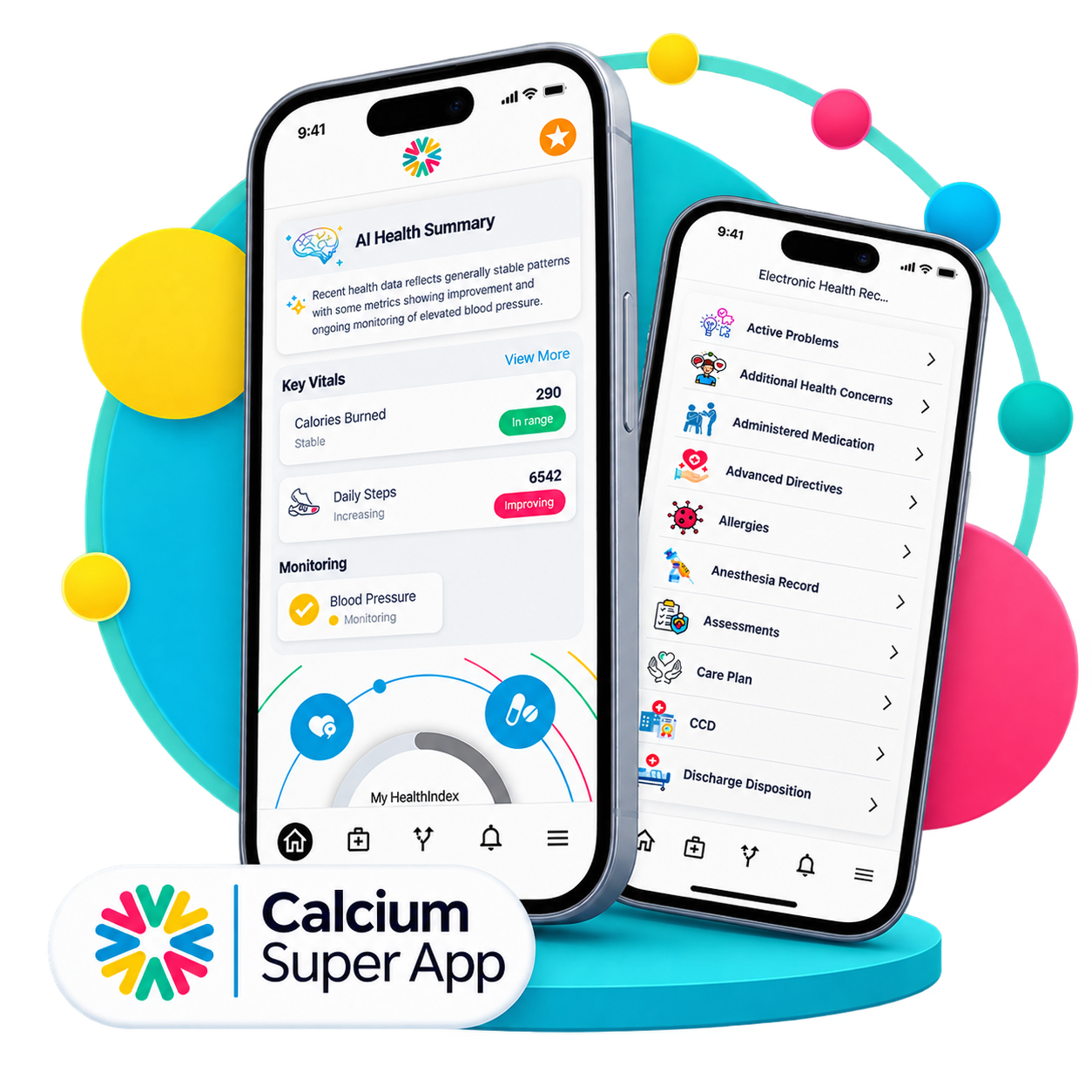
Calcium Super App
Patient-Empowering App
The Calcium Super App gives patients a place to participate in assigned pathways, track medications, record health information, and access supported records and connected device data. Authorized sharing can make relevant updates available to their care team. For partners, the app may help meet growing expectations for a useful digital experience outside the clinic.
WHO WE PARTNER WITH
Find the Opportunity That Fits Your Healthcare Business
Different partner specialties. A shared commitment to customer value.
Calcium is interested in relationships with companies that already serve healthcare providers and understand their operational or clinical priorities. The strongest opportunities typically occur when a vendor’s offering and Calcium’s capabilities solve different but related problems.
We welcome conversations with software firms, consultants, technology specialists, and service organizations across healthcare. The following examples show where shared customer needs may create a useful starting point; they are not automatic eligibility categories.

Healthcare Software Technology Vendors
EHR and practice software vendors can explore complementary patient engagement, broader longitudinal information, and digital care capabilities when customers need more than the core application provides. Customer fit and potential product overlap should be reviewed.

Practice Consulting Management Firms
Consultants and management services organizations can bring additional digital options to client practices seeking more efficient follow up and patient experiences. Calcium can lead platform evaluation while the adviser remains focused on its consulting relationship.

Membership Medicine Software Providers
Vendors serving concierge, direct primary care, functional, and lifestyle practices can help clients extend more personalized care beyond visits. Digital Pathways and 360° health insights complement membership administration, communications, and related services.

Device Monitoring Technology Vendors
Medical device and remote monitoring vendors can explore engagement use cases around supported measurements. A partnership may help customers connect readings with clinician directed education, check ins, and care processes when integration requirements are met.

Surgical Operations Service Vendors
Companies serving surgeons, ambulatory surgery centers, and perioperative teams can introduce digital preparation and recovery engagement capabilities. Calcium may complement existing scheduling, operational, or clinical tools through carefully scoped surgical workflows and patient follow up.

Population Health Analytics Firms
Value based care and population health vendors can explore engagement workflows that complement risk identification or reporting. Calcium pathways may support clinician directed outreach and patient participation when each organization’s data, governance, and requirements align.
THE BUSINESS VALUE OF PARTNERSHIP
Build More Value Into Every Client Relationship
New options for customers can create strategic advantages for your company.
Partnerships work best when the benefits extend beyond a one time introduction. A relevant Calcium recommendation can help your organization respond more effectively to clients, reinforce its position as a trusted business adviser, and participate in additional revenue opportunities.
None of these outcomes is guaranteed; they depend on choosing appropriate customers, making useful introductions, and maintaining high service standards. The objective is to develop a repeatable, mutually beneficial way to help healthcare clients succeed.


Create Additional Revenue Opportunities
Your organization already invests in winning and serving healthcare customers. When a client has a suitable need for Calcium, an approved introduction may generate referral compensation on eligible first year revenue. The opportunity builds on established relationships rather than requiring a completely separate product or customer acquisition strategy.

Strengthen Existing Client Relationships
Clients value vendors that recognize their wider challenges and recommend relevant next steps. By introducing a complementary digital health solution when appropriate, you can stay involved in important conversations and reinforce your position as a helpful partner. The recommendation should always serve the client’s interests before any commission.

Differentiate Your Core Offering
Your company does not need to promise every digital health feature to offer broader value. Calcium may help you introduce provider dashboards, patient engagement, and guided care pathways alongside your existing strengths. That conversation can support differentiation while allowing your team to remain focused on its primary business.
A PARTNERSHIP IN ACTION
See How One Client Need Becomes a Shared Opportunity
A practical example of how complementary solutions can come together.
Imagine a company whose software supports concierge medical practices. During a regular account conversation, a physician asks for a more structured way to follow patient progress between visits. The vendor does not need to build that functionality immediately or promise an integration that has not been evaluated.
Instead, it can introduce Calcium for a focused discussion. This hypothetical scenario shows how an appropriate referral can create customer value while allowing each company to retain its role.

1. Recognize Client Needs
A concierge practice tells its membership software provider that patients need ongoing guidance for blood pressure checks and preventive care. The vendor identifies a need that is adjacent to, rather than identical with, its existing offering.

2. Make Relevant Introductions
The vendor discusses Calcium as one possible complementary option and asks whether the practice would welcome an introduction. With permission, the partner submits the business opportunity for eligibility review and connects the relevant customer decision makers.

3. Explore Product Fit
Calcium meets the practice to understand its care program, information requirements, and staffing workflows. The Calcium team demonstrates the most relevant platform capabilities while identifying technical questions, clinical responsibilities, and any limitations that require further evaluation.


4. Support Client Decisions
The practice decides whether Calcium fits its priorities, timeline and budget. Calcium handles product evaluation, commercial discussions, and implementation scoping, while the original vendor remains available to discuss its own solution and any mutually agreed coordination.

5. Recognize Partner Value
If the practice becomes a paying Calcium customer through an accepted, eligible referral, the partner can receive compensation according to the approved agreement. Both companies continue serving the client within their respective contractual and operational responsibilities.
WAYS TO WORK TOGETHER
Choose the Partnership Model That Fits Your Business
Begin with introductions and explore deeper collaboration when it makes sense.
Some organizations want a straightforward referral relationship. Others may have audiences suited to educational co-marketing, or technology that could support a carefully scoped integration. Calcium can discuss these different possibilities without requiring every prospective partner to commit to all of them.
The initial program prioritizes qualified business introductions because responsibilities are easier to define. More complex marketing, distribution, and technology arrangements should be evaluated and negotiated separately based on mutual customer needs.

Referral Partnerships
Introduce an eligible healthcare provider prospect whose needs fit Calcium’s platform. After the lead is accepted, our team manages evaluation, demonstrations, contracting, and customer delivery. Qualified new revenue can generate approved first year commissions under a written agreement.

Co-Marketing Partnerships
Collaborate on targeted healthcare educational webinars, provider focused content, approved client communications, or joint campaigns. Both organizations agree on the audience, messaging, responsibilities, and permitted data use before launching activities. Marketing efforts do not automatically create commission eligibility.

Strategic Partnerships
Explore opportunities involving supported integrations, complementary workflows, co selling, or larger distribution relationships. These arrangements require additional technical, commercial, privacy, and operational review. The parties define customer ownership, support obligations, and economics separately from the standard referral model.
A REVENUE OPPORTUNITY
Make More of the Client Relationships You Already Have

Eligible introductions can create a new source of business income.
Your existing client relationships can create commercial opportunities beyond the products and services you currently sell. When a provider has a genuine need for Calcium and chooses to become a customer, an approved referral arrangement may compensate your organization for that introduction.
The offer is meant to reward qualified, compliant new business, not the transfer of patient information or referrals for clinical services. Program eligibility, attribution, commissionable revenue, and payment timing are set out in the approved agreement.
10%–13.5% of Eligible First-Year Revenue
Approved partners may qualify for a commission within Calcium’s current first-year range when an accepted referral results in eligible new customer revenue, subject to the signed agreement and applicable legal requirements.
No requirement to resell or implement Calcium under the standard referral model.
Calcium manages its direct customer sales and delivery.
PARTNER SUPPORT & RESOURCES
The Tools and Support to Make Introductions Easier
Useful materials, clear answers, and Calcium-led product conversations.
Your team’s first responsibility is to its own business and customers. A good referral program should recognize that reality, not create a second sales job for every account manager.
Calcium plans to support approved partners with concise product information, audience specific materials, introduction templates, and access to knowledgeable team members. The goal is to help you identify relevant client needs and make a confident introduction without requiring your staff to master every feature of the platform.

Approved Marketing Resources
Use Calcium reviewed company overviews, approved partner messaging, and introductory materials to explain the opportunity consistently. Approved content helps protect client trust and reduces the time your team spends drafting new communications for every prospect.

Specialty Sales Materials
Access focused explanations for relevant provider segments, including membership medicine, surgical care, and value based programs. Each resource connects likely client needs with supportable Calcium use cases instead of relying on broad, unverified outcome promises.

Calcium Product Demonstrations
Our team can present the platform directly to interested providers, explain appropriate workflows, and discuss questions about available features. The customer evaluation also identifies where integration, staffing, clinical oversight, or technical validation will be necessary.

Dedicated Partnership Support
Work with a Calcium contact to coordinate accepted opportunities, marketing plans, and next steps. Clear ownership helps prevent confusion about who responds to customers, provides technical answers, and manages the continuing business relationship after introduction.
FAQ
1. Who can become a Calcium partner?
Calcium is interested in commercial organizations that already serve healthcare providers and can identify relevant needs for complementary digital health capabilities. Potential partners include software vendors, technology consultants, practice advisers, management service organizations, device companies, and specialized healthcare service firms. Participation is not automatic. We evaluate each prospect’s customer relationships, product overlap, planned proposed activities, and compliance considerations before approval. The final arrangement and eligibility requirements are documented in an authorized formal written partnership agreement.
2. Do we need to be a healthcare software company?
No. Calcium also welcomes conversations with consulting businesses, practice management organizations, healthcare services firms, and other vendors whose customers include relevant healthcare provider organizations. What matters most is whether you understand the needs of your healthcare clients and can identify appropriate introductions. A strong relationship with a clearly defined customer segment may be more useful than a large but loosely connected audience. Every proposed arrangement remains subject to business assessment, legal review, and written approval.
3. How does the referral program work?
An approved referral partner identifies a healthcare organization that may benefit from Calcium and confirms that the prospect welcomes an introduction. The partner then registers the opportunity through the agreed process. Calcium reviews eligibility, coordinates the conversation, and typically manages demonstrations, proposals, contracting, and customer delivery. If the accepted referral results in qualifying new revenue, the partner may receive compensation under its signed agreement. The process is designed to clarify responsibilities and avoid duplicate claims.
4. What referral commission does Calcium offer?
Calcium’s current referral compensation range is ten percent to thirteen and one half percent of eligible first year customer revenue. The applicable rate depends on the approved arrangement, qualifying activities, and written terms. Payment is not automatically earned when a name is submitted or a contract is signed. Eligibility, revenue definitions, timing, refunds, and exclusions must be established in the agreement and reviewed for compliance with applicable healthcare laws before the program is publicly offered.
5. What revenue counts toward a referral commission?
Commissionable revenue is the portion of eligible first year customer revenue defined in the signed partner agreement. Calcium should clarify whether recurring subscriptions, onboarding charges, discounts, taxes, refunds, pass through expenses, or expansions are included or excluded. A contract amount alone may not determine the payment. The program’s proposed approach is to calculate compensation on qualified revenue actually collected, subject to the agreed terms. Finance can explain the calculation before any partner begins submitting referrals.
6. What makes a referral qualified?
A qualified referral should involve a healthcare organization with a relevant need, a suitable contact, and genuine interest in learning more about Calcium. The introduction must be permitted, appropriately registered, and accepted before compensation eligibility is established. Calcium also checks for an existing opportunity or a competing claim from another partner. A purchased contact list or unsolicited transfer of personal or patient information is not a qualified introduction. The written agreement governs final qualification criteria.
7. What happens if Calcium already knows the prospect?
Calcium should evaluate whether the organization is already an active customer, sales opportunity, or previously accepted referral. If so, the new submission may not qualify for compensation, depending on the agreement and documented history. We recommend checking prospect status before the partner invests time in a coordinated introduction. Clear lead registration rules, reasonable protection periods, and transparent dispute procedures help prevent confusion. Any special treatment for existing relationships must be approved and documented in advance.
8. Who owns the customer relationship after introduction?
Under the standard referral model, Calcium contracts directly with the healthcare customer and remains responsible for its own product, service commitments, onboarding, and account management. The partner maintains its separate commercial relationship with the customer for its offerings. Both organizations should agree on appropriate communications, confidentiality, and any needed coordination. More complex co selling or reseller relationships require separate terms. Referral participation does not automatically transfer customer ownership, healthcare records, or contractual obligations between companies.
9. Does our team need to sell or implement Calcium?
Not under the standard referral arrangement. Partners identify suitable opportunities and make an appropriate introduction. Calcium normally takes responsibility for product demonstrations, technical evaluation, proposals, pricing discussions, contracts, implementation planning, and ongoing platform support. A partner may choose to participate in selected relevant meetings when doing so helps the customer, but additional activities should be agreed explicitly. Deeper reseller, integration, and service delivery arrangements are separate models, with their own scope, staffing, and commercial terms.
10. Is a technical integration required to participate?
No. A referral partnership can begin with an accepted introduction to a healthcare organization whose needs fit Calcium’s current capabilities. A technical integration is not automatically required or promised. If the customer seeks connected workflows or data exchange between systems, Calcium and the relevant parties can evaluate available interfaces, information access, security obligations, resource needs, and implementation costs. Any proposed integration should be scoped and approved separately before it becomes part of a customer commitment.
11. Will Calcium compete with our existing product?
Our intention is to identify complementary use cases, not to assume that every partnership is free of competitive overlap. Calcium has broad digital health capabilities, so some existing features may intersect with a vendor’s current offerings. We recommend reviewing products, target customers, roadmaps where appropriate, and the proposed collaboration before signing. Clear scope, confidentiality commitments, and agreed communications help protect both businesses. We would rather recognize a conflict early than create a problematic customer experience.
12. Can we collaborate on webinars and marketing?
Yes, co marketing may be appropriate when the companies serve related audiences and can offer useful content. Potential activities include webinars, approved newsletters, joint presentations, targeted campaigns, and co branded resources. Both parties should agree on the audience, claims, branding, responsibilities, consent requirements, and treatment of leads before launch. A marketing collaboration does not automatically establish referral commission rights. Those financial terms require an eligible, approved arrangement and should remain separate from clinical referral activity.
13. Can we share client or patient information with Calcium?
Partners should share only the business contact information necessary for a permitted introduction, under applicable laws, customer expectations, and established agreed privacy procedures. Ordinary referral submissions should not include patient lists, health records, treatment information, or other protected health information. If a different collaboration genuinely requires regulated information, the parties must first determine the lawful basis and necessary agreements. Each organization remains responsible for safeguarding information it receives and using it only for authorized purposes.
14. When and how are partner commissions paid?
Payment timing is established in the approved referral agreement. Calcium recommends linking compensation to eligible first year revenue actually received rather than treating a new lead or signed contract as immediate income. The agreement should identify calculation methods, review and approval procedures, timing, and adjustments for cancellations, refunds, or nonpayment. Partners should receive reporting about registered opportunities and approved payouts. Exact timing and rates must be confirmed in writing before referrals are submitted for compensation.
15. How do we get started with Calcium?
Begin by completing the partner inquiry form with your contact details, company website, customer segments, and partnership interests. Please do not include any patient information. A Calcium representative can review the submission and arrange a discussion about potential fit, complementary use cases, and available partnership models. If both parties wish to proceed, Calcium will coordinate qualification, review, and written terms before any paid referrals begin. There is no need to promise introductions before that conversation.