
Digital Health Platform for Behavioral Health
Behavioral Health Happens Every Day. Care Should Too.
Extend behavioral healthcare beyond the encounter.
Calcium helps keep patients connected to their care journey between visits—while giving behavioral-health teams greater visibility into engagement, adherence, progress, and meaningful changes that may warrant attention.
Continuous Patient Engagement
Calcium helps turn the time between appointments into an active part of the care journey—reinforcing clinician-directed treatment without requiring your team to manually initiate every patient interaction.

Between-Visit Visibility
Calcium brings patient responses, pathway participation, health information, medication activity and other signals into a longitudinal provider environment designed to help care teams understand progress and recognize changes.
Personalized Digital Pathways
Configure questions, activities, education, reminders, check-ins, alerts, and conditional logic around different populations and programs—extending structured care into everyday life while keeping your clinical expertise at the center.
THE BEHAVIORAL HEALTH CHALLENGE
Behavioral Health Is Continuous. But Behavioral Healthcare Is Still Largely Episodic.
Behavioral healthcare is built around meaningful human relationships, but those relationships operate within an encounter-based delivery system. The clinician may have an hour with a patient while the patient spends hundreds of hours navigating everyday life before the next visit. That creates an important digital opportunity: not to replace clinical care, but to connect the treatment experience with the many decisions, behaviors, symptoms, medications, and challenges that occur outside the treatment setting.
The Between-Visit Blind Spot
Capture changing patient signals between visits for greater continuity and clinical visibility.
Engagement & Retention Gap
Keep patients connected through ongoing digital guidance, check-ins, reminders, and encouragement.
The Metrics Gap
Streamline progress tracking with structured check-ins, pathway responses, and longitudinal patient trends
Fragmented Patient Picture
Connect authorized health information to create a more complete longitudinal patient view.
The Care Continuity Gap
Maintain patient engagement and context as care extends across providers and settings.
Workforce & Prioritization
Automate routine engagement while focusing limited clinical resources where they matter most.
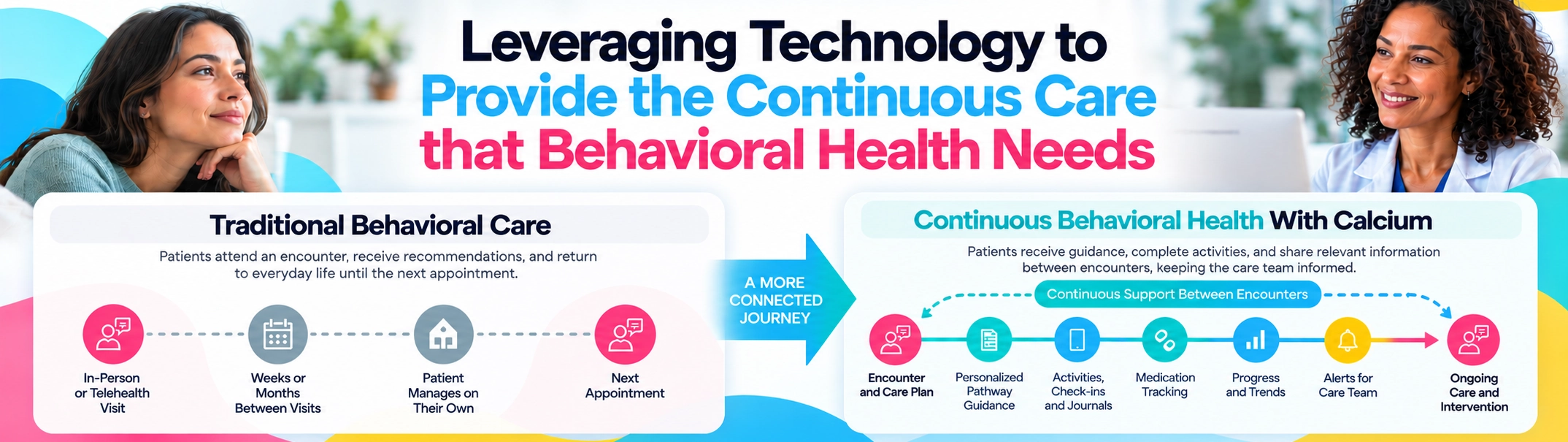
Most behavioral-health technology has been designed around discrete moments: scheduling an appointment, documenting a session, prescribing medication, conducting a telehealth visit, or submitting a claim. Calcium addresses the space connecting those moments. By linking provider guidance with patient activity between encounters, behavioral-health organizations can create a more continuous care experience while preserving the clinician’s role in assessment, treatment decisions, therapeutic relationships, and appropriate intervention.
Traditional Behavioral Care
The traditional model can leave long stretches between meaningful touchpoints. A patient attends an encounter, receives recommendations, returns to everyday life, and is expected to remember and carry out the plan until the next appointment.
The provider may receive little structured information during that interval, making the next encounter responsible for reconstructing what occurred over the preceding days or weeks.
Continuous Behavioral Health With Calcium
Calcium creates a digital connection throughout the interval between encounters. Patients can receive pathway guidance, complete treatment activities, respond to questions, manage medications, and record relevant information.
Their participation can become visible through Calcium Core, helping the care team maintain greater awareness of the journey while deciding when additional human contact, assessment, or intervention is appropriate.
A MORE CONTINUOUS MODEL OF CARE
Extend Behavioral Healthcare Beyond the Encounter.
The opportunity is not to make behavioral healthcare less human. It is to use technology where technology is most useful: maintaining continuity, reinforcing treatment, collecting information, and organizing signals between human interactions.
Calcium creates a digital layer around clinician-directed care so that patients can remain connected to their treatment journey while providers gain a richer understanding of what is happening outside the traditional encounter.
1. See More
Build a more longitudinal understanding of the patient by connecting available clinical information with patient-reported information, Digital Pathway activity, medication information, connected health data, and other authorized sources.
Instead of relying only on the most recent encounter, care teams can gain additional context around the patient’s health journey, participation, behaviors, and changes over time.
2. Guide Continuously
Extend clinician-directed treatment into everyday life with personalized Digital Pathways. Deliver structured activities, questions, education, reminders, medication support, check-ins, and health-data collection through the Calcium Super App.
Patients receive clear next steps between encounters, while providers can reinforce important elements of treatment without requiring every interaction to begin with manual staff outreach.

3. Measure Progress
Capture information throughout the care journey rather than waiting for the next appointment to reconstruct what happened. Patient responses, assessments, pathway completion, symptoms, behaviors, and other available information can create a richer longitudinal record of participation.
Providers can review those patterns alongside clinical context to support more informed conversations about progress and treatment.

4. Prioritize Attention
Continuous information becomes useful when it helps care teams understand where to focus.
Calcium can organize alerts, patient status, pathway activity, recent responses, and changing health information so clinicians can more efficiently identify situations that may warrant closer review. The objective is not more alerts—it is helping scarce clinical attention become more focused and actionable.

5. Scale Behavioral Care
Behavioral-health organizations can extend structured support to larger populations without turning every interaction into manual work.
Digital Pathways can automate recurring education, reminders, questions, treatment activities, and check-ins while Calcium Core centralizes the resulting information for review. This creates a scalable layer of digital support around the human relationships that remain essential to behavioral healthcare.
EXTEND THE TREATMENT PLAN
Turn Treatment Plans Into Everyday Action.
Behavioral-health professionals already know what they want patients to work on between encounters. The challenge is translating those recommendations into something patients can consistently follow without creating a new manual workload for the care team.
Calcium Digital Pathways provide a configurable delivery mechanism for that expertise, turning treatment programs and protocols into structured digital experiences that can unfold over days, weeks, months, or longer.
Treatment Activities
Turn clinician-directed recommendations into structured pathway activities that reinforce therapeutic assignments, coping strategies, recovery goals, behavioral changes, and self-management routines between scheduled care encounters.

Patient Check-Ins
Capture structured patient feedback between appointments through recurring check-ins covering symptoms, experiences, treatment participation, recovery activities, and other provider-defined topics throughout the care journey.

Health Education
Deliver relevant education throughout treatment, helping patients build health literacy, treatment understanding, recovery knowledge, and self-management skills when information is most useful to them.
Medication Support
Support clinician-directed medication plans with schedules, reminders, information, and adherence tracking integrated alongside education, check-ins, appointments, and other pathway activities throughout the care journey.
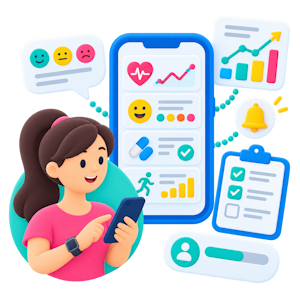
Assessments & Questions
Embed structured questions and assessments throughout Digital Pathways, providing care teams with longitudinal patient information to consider alongside clinical assessment, professional judgment, and treatment decisions.
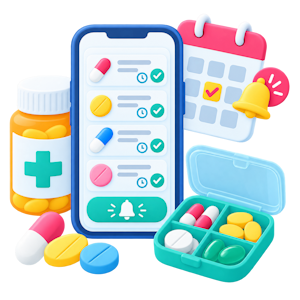
Reminders & Motivation
Keep patients moving forward with automated reminders and supportive messaging for pathway activities, medications, appointments, questions, and care-plan tasks without requiring continuous manual staff outreach.
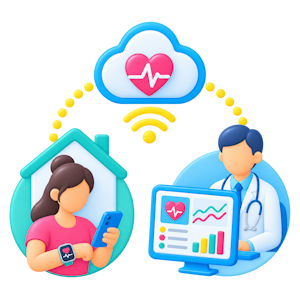
Progress Tracking
Create a longitudinal record of patient participation, responses, and completed activities, helping patients recognize progress while giving providers additional context for meaningful treatment conversations over time.
Configurable Alert
Configure alerts around selected patient responses or pathway events, helping direct provider attention toward organization-defined situations while preserving clinician responsibility for assessment and appropriate response.
SUBSTANCE USE & ADDICTION CARE
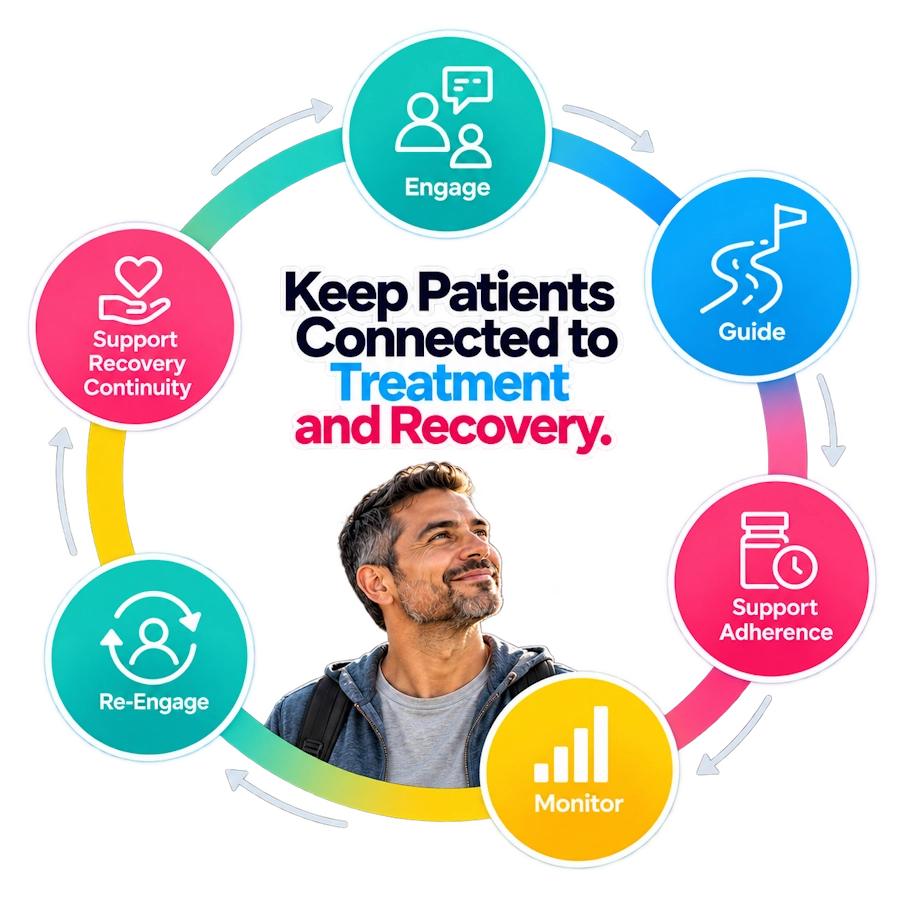
Extend Recovery Beyond the Treatment Encounter
Recovery does not occur only inside treatment facilities, counseling sessions, or medication appointments. It unfolds through everyday decisions, challenges, routines, relationships, and changes in readiness. That makes continuity particularly important for organizations serving people with substance use disorders.
Calcium can provide a digital layer around clinician-directed addiction treatment, helping programs maintain structured connection and gather relevant information throughout the recovery journey without positioning technology as a substitute for professional treatment.
Engage
Maintain an ongoing digital connection between formal treatment encounters with pathway activities, check-ins, education, reminders, and supportive messaging.
This gives organizations another mechanism for keeping patients connected to their treatment journey during the days and weeks between appointments. For SUD programs focused on engagement and retention, digital touchpoints can complement the therapeutic relationships and services delivered by the care team.
Guide
Translate clinician-directed recovery plans into structured digital activities patients can follow in everyday life. Pathways can reinforce coping strategies, recovery goals, educational content, appointments, treatment assignments, wellness activities, and other provider-defined components of care.
The objective is not to prescribe a universal recovery experience, but to give each organization a flexible digital mechanism for extending its own treatment model beyond the encounter.
Support Adherence
Medication and treatment adherence can be important components of addiction care, including programs involving medications for opioid or alcohol use disorders. Calcium can support clinician-directed care with medication reminders, treatment activities, education, check-ins, and adherence-related information.
These tools help reinforce the plan established by qualified providers without positioning Calcium as the prescriber, treatment decision-maker, or replacement for clinical monitoring.
Monitor
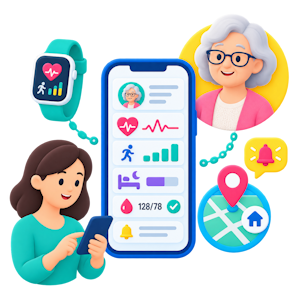
Gain greater visibility into pathway participation, patient responses, treatment activities, and other available information over time.
Rather than waiting until the next encounter to learn whether a patient remained engaged with selected elements of the care plan, providers can review ongoing pathway information through Calcium Core. This can add context to clinical conversations and help teams understand the patient’s recovery journey between formal touchpoints.

Re-Engage
Disengagement does not have to mean the end of the digital relationship. Organizations can configure reminders, pathway prompts, and other engagement workflows that encourage patients to reconnect with selected treatment activities.
When participation changes, pathway information can also provide additional context for care teams considering outreach. This supports a care philosophy in which reconnecting patients remains an important part of the treatment continuum.
Support Recovery Continuity
Recovery journeys may move across residential, inpatient, partial hospitalization, intensive outpatient, outpatient, medication-based treatment, and continuing-care environments. Digital Pathways can provide a structured thread that evolves with the patient’s care plan.
Organizations can configure different guidance for different phases, helping maintain treatment momentum and patient connection as the intensity, setting, and objectives of care change over time.
ONE CONNECTED PLATFORM
Connect Provider Expertise, Patient Action and Continuous Insight.
Continuous behavioral healthcare requires more than a patient app or provider dashboard operating alone. The experience has to connect what the organization wants patients to do, what patients actually experience between encounters, and what providers need to understand about that journey.
Calcium brings those functions together through three integrated platform components, creating an environment where clinical expertise can become structured guidance and patient activity can flow back into provider visibility.
Calcium Core
See the Journey Unfold
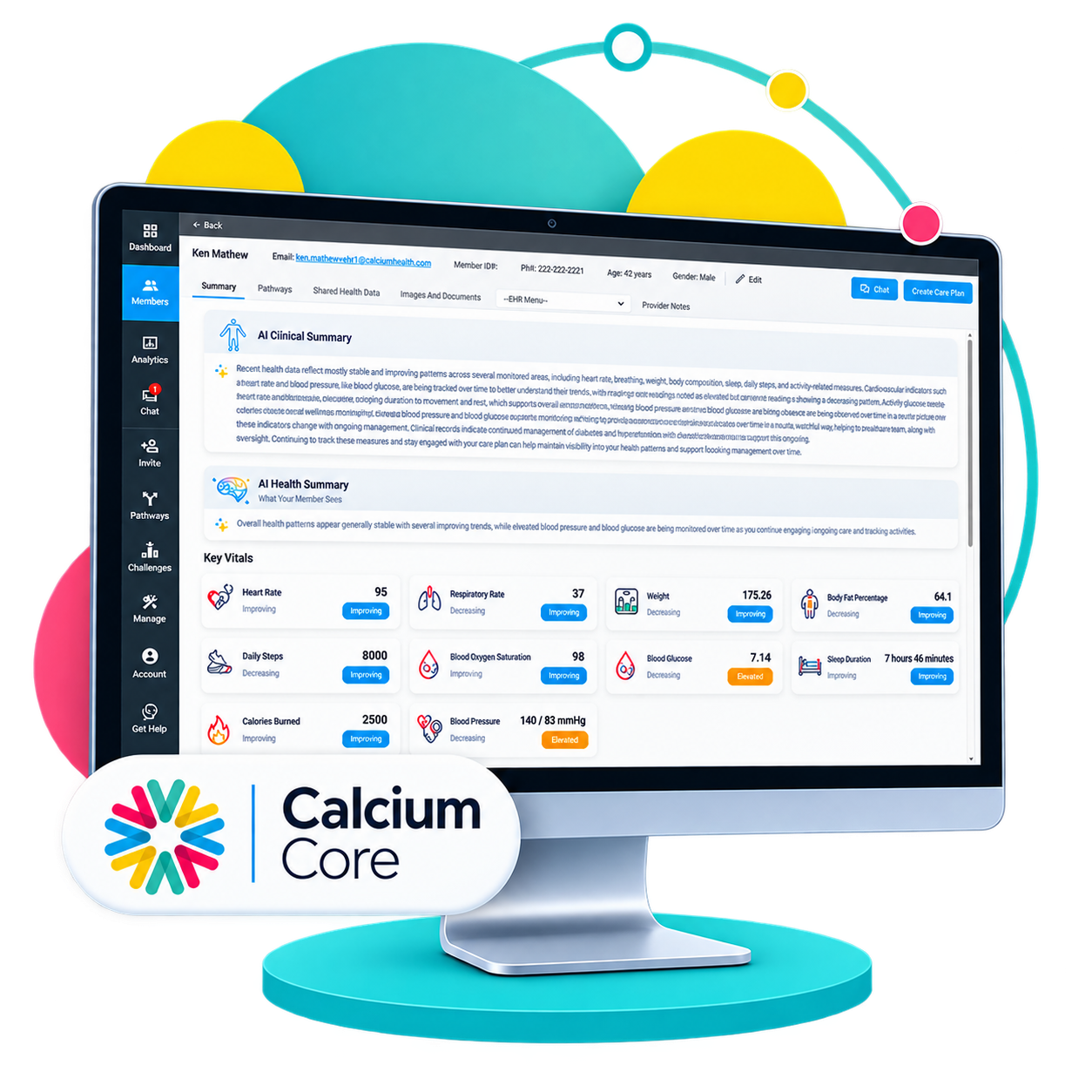
Bring clinical information, patient-generated data, Digital Pathway activity, health information, trends, alerts, analytics, and engagement tools into one provider-facing environment. Calcium Core helps care teams see more of what is happening beyond individual encounters, monitor patient participation and progress, and review situations that may warrant attention—creating the provider intelligence layer behind continuous behavioral healthcare.
Calcium AI Studio
Build the Digital Treatment Experience
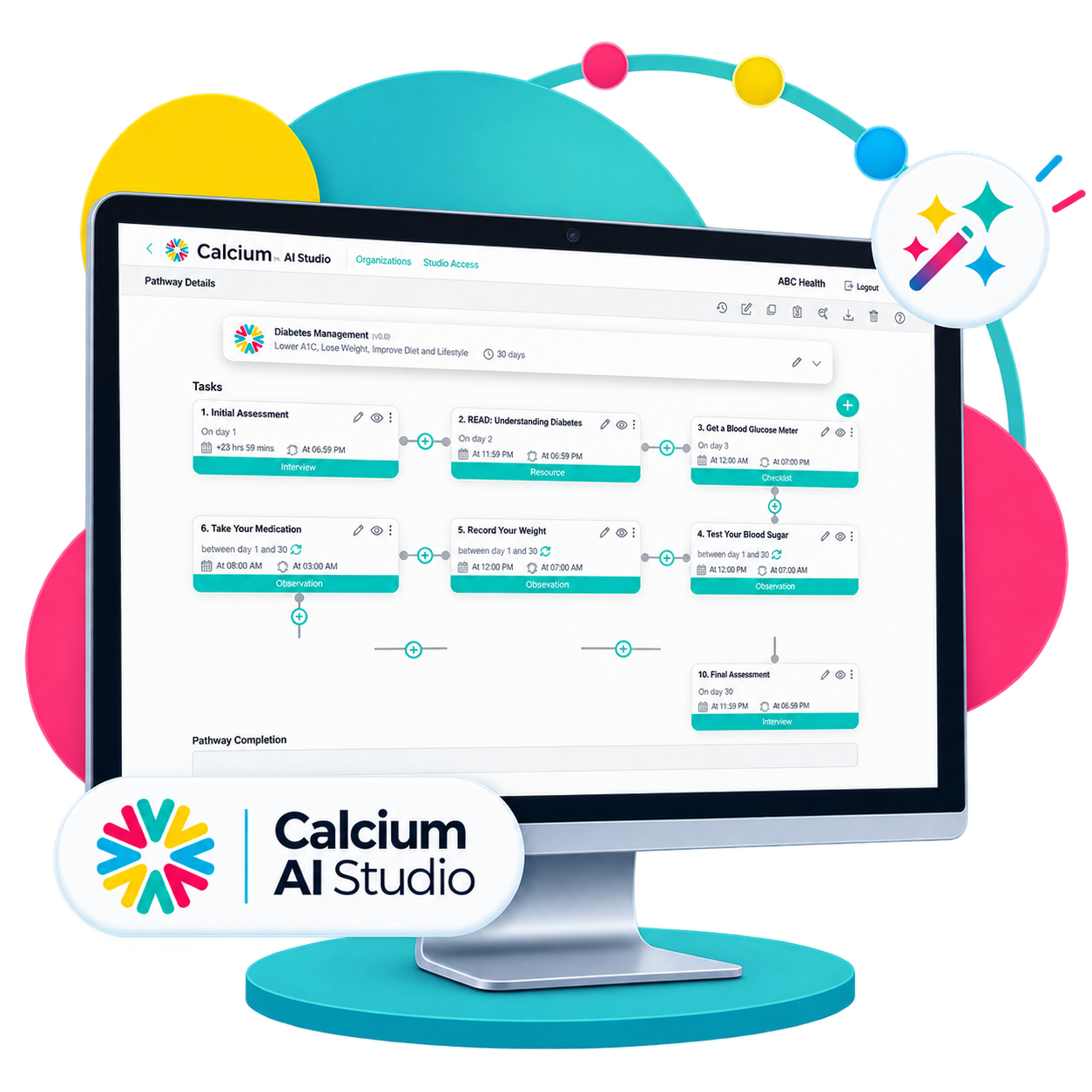
Turn your organization’s behavioral-health expertise, programs, protocols, and treatment objectives into configurable Digital Pathways. Create or modify tasks, questions, education, reminders, alerts, sequencing, and conditional logic, then deploy those pathways through the Calcium platform. Your team retains control over the clinical experience while gaining a more flexible way to translate care models into repeatable digital workflows.
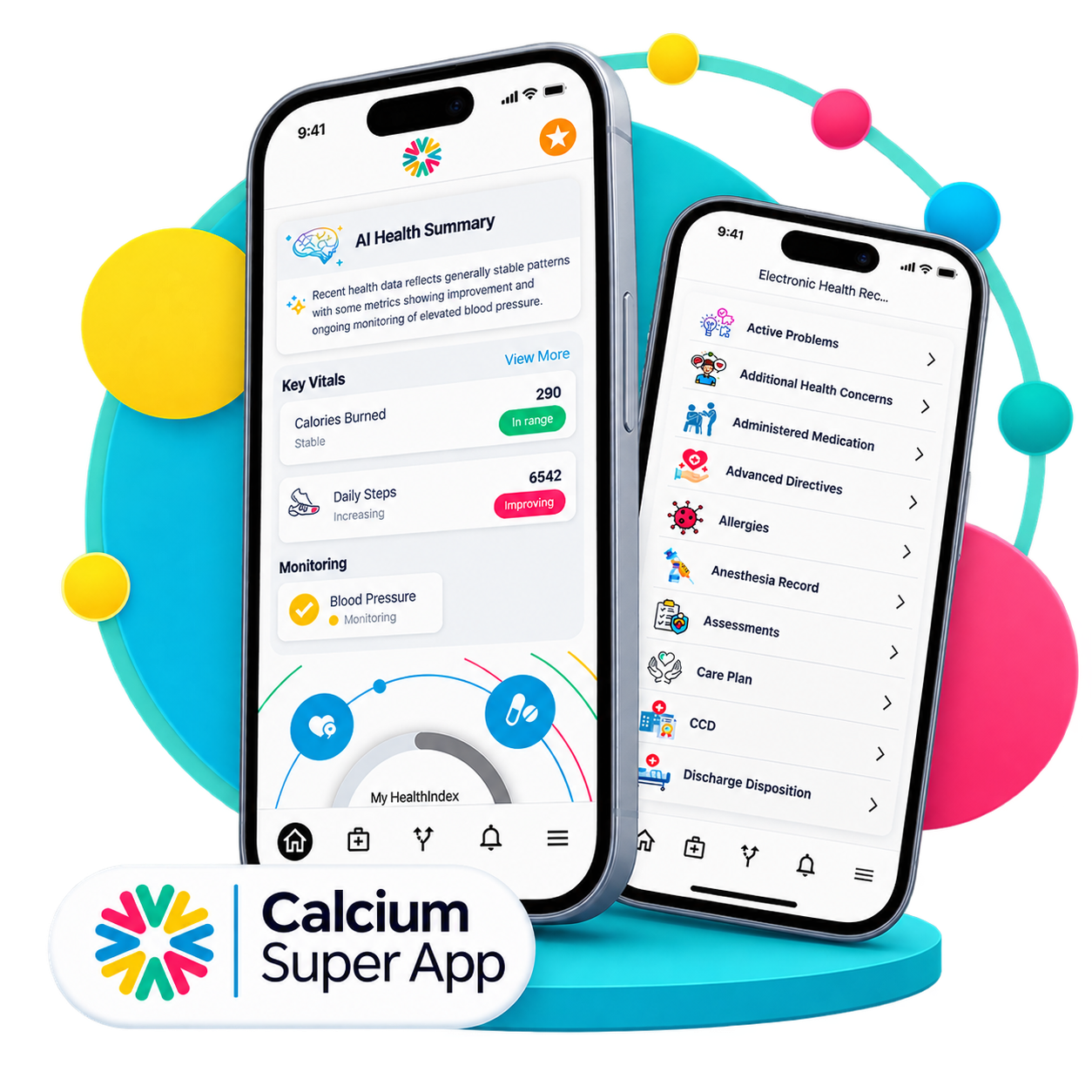
Calcium Super App
Put the Care Plan in the Patient’s Hands
Give patients one digital environment for following assigned pathways, managing medications, recording health information, accessing supported health records, connecting health apps and devices, journaling, and tracking relevant health information. Instead of asking patients to navigate another single-purpose tool, Calcium provides a broader personal health environment that can support behavioral-health treatment within the context of everyday health.
Why Calcium?
Moving Beyond Predictive Analytics to Predictive Prevention.
Healthcare organizations have invested heavily in data, analytics, and population health intelligence. The next opportunity is to build on those capabilities with an operating model that connects intelligence more directly to the patient journey. Calcium’s Predictive Prevention Framework represents this evolution—transforming how healthcare organizations use information, engage patients, support care teams, and operationalize prevention across increasingly complex populations and care environments.
From Identifying Risk to Predicting, Prioritizing and Preventing
Traditional analytics identifies risk. Predictive Prevention helps determine what happens next. Rather than stopping with a risk score, Calcium extends analytics into a continuous framework that helps identify emerging risk, prioritize patients who may need attention, and connect those insights to guided interventions.
This creates a clearer pathway from prediction to prevention. Care teams gain more than visibility into which patients may be vulnerable—they gain an operating model designed to help translate risk intelligence into timely patient engagement and appropriate care-team action.
From Static Dashboards to Continuous Engagement
Traditional analytics often presents information through dashboards. Predictive Prevention extends intelligence into continuous engagement. Dashboards can provide valuable visibility into patient populations, but information alone does not engage patients between encounters.
Calcium connects risk intelligence with personalized Digital Pathways that can deliver education, assessments, reminders, monitoring, and behavioral guidance throughout the healthcare journey. As patients participate, new information can become available to care teams. This creates an ongoing connection between health intelligence, patient activity, and care delivery rather than leaving insights primarily within reporting environments.
From Manual Outreach to Automated Digital Pathways
Traditional care management frequently depends on manual outreach. Predictive Prevention adds scalable, automated Digital Pathways. Instead of requiring staff to initiate every routine interaction, Calcium can automate personalized education, reminders, assessments, health tracking, and other engagement activities based on configured workflows.
Care teams can then concentrate more of their attention on patients requiring human expertise or additional support. By combining digital automation with defined escalation processes, Predictive Prevention helps organizations expand proactive engagement across larger populations without making every preventive interaction dependent on additional manual care-team capacity.
From Episodic Care to Longitudinal Care
Traditional healthcare is largely organized around individual encounters. Predictive Prevention supports a more longitudinal approach. Patient risk, behaviors, symptoms, and needs can change considerably between scheduled visits, creating gaps in visibility and opportunities for earlier intervention.
Calcium helps maintain a continuous digital connection through ongoing data assessment, patient engagement, monitoring activities, and guided interventions. This allows healthcare organizations to view prevention as an ongoing process rather than an activity limited to appointments—supporting a more connected understanding of the patient journey as health needs and risk evolve over time.
From Insight to Action
Traditional analytics generates valuable insight. Predictive Prevention is designed to make that intelligence more actionable. Knowing that a patient has elevated or rising risk creates an opportunity, but care teams still need a practical way to respond.
Calcium connects predictive intelligence with patient prioritization, provider workflows, Digital Pathways, and defined escalation processes. This helps organizations move from understanding what may be happening across their populations toward determining appropriate next steps—creating a more direct connection between available health intelligence, patient engagement, care-team attention, and proactive intervention.
From Reports to Measurable Outcomes
Traditional analytics often culminates in reports. Predictive Prevention extends the process toward measurable action and outcomes. Calcium creates a closed-loop framework in which organizations can assess health information, identify emerging risk, prioritize attention, deliver guided interventions, and capture new information as patients progress.
This enables teams to evaluate what happened after risk was identified rather than treating reporting as the endpoint. With clearly defined program objectives and performance measures, organizations can better understand engagement, interventions, workflows, patient trajectories, and the results their prevention initiatives are designed to influence.
FAQ
1. What is the Calcium Behavioral Health solution?
Calcium is a connected digital-health platform that can help behavioral-health organizations extend structured care beyond individual encounters. It combines Calcium Core for provider intelligence, Calcium AI Studio for creating and configuring Digital Pathways, and the Calcium Super App for patient engagement.
Together, these capabilities connect ongoing guidance, patient activity, health information, and provider oversight within one continuous digital environment.
2. Does Calcium replace our behavioral-health EHR?
Calcium is not positioned as a replacement for the systems behavioral-health organizations use to document and manage clinical encounters. Its primary value is extending visibility and structured engagement beyond those encounters. Calcium can bring supported clinical and patient-generated information together with Digital Pathway activity, connected health information, analytics, and engagement tools to create a more longitudinal layer around existing care delivery.
3. How does Calcium help engage patients between visits?
Providers can assign Digital Pathways that deliver recurring activities, questions, education, reminders, medication support, check-ins, and health-data collection through the Calcium Super App. Instead of relying solely on the next scheduled appointment, patients receive structured guidance throughout the interval between encounters. Their pathway participation and responses can then become visible to authorized care teams through Calcium Core.
4. Can Calcium support measurement-based care?
Calcium can provide digital infrastructure useful for organizations implementing measurement-based approaches, including recurring questions, assessments, patient-reported information, and longitudinal review of responses. APA describes measurement-based care as regular use of quantitative patient information to track progress and inform treatment. Organizations remain responsible for selecting appropriate measures, licensing where applicable, clinical interpretation, workflows, and treatment decisions.
5. How can Calcium support substance-use and addiction treatment?
Calcium can extend clinician-directed addiction treatment into everyday life through recovery-oriented Digital Pathways, treatment activities, education, check-ins, medication support, reminders, patient feedback, and ongoing engagement. Providers can review pathway participation and other supported information through Calcium Core. This can help programs reinforce engagement, continuity, and re-engagement strategies without positioning Calcium as a replacement for professional addiction treatment.
6. Can Calcium support medication-based addiction treatment?
Calcium can support the digital engagement surrounding clinician-directed medication treatment with medication reminders, education, treatment activities, check-ins, appointment prompts, and adherence-related information. This can complement programs involving medications for opioid or alcohol use disorders. Calcium does not prescribe, dispense, administer, or independently manage these medications, and it does not replace the clinical monitoring or regulatory workflows required by treatment programs.
7. Can we create our own behavioral-health Digital Pathways?
Yes. Calcium AI Studio is designed to help organizations create, configure, and manage Digital Pathways around their own programs, protocols, conditions, and patient needs. Teams can configure tasks, questions, educational content, reminders, alerts, sequencing, and conditional logic, then deliver pathways through the Calcium Super App and monitor relevant activity through Calcium Core. Pathways can also evolve as programs change.
8. What patient information can providers see through Calcium Core?
Depending on available connections, patient authorization, and organizational configuration, Core can bring together clinical records, medications, diagnoses, labs, procedures, vital signs, patient-generated information, Digital Pathway responses, connected-device data, health-app information, analytics, trends, alerts, and other supported information. The objective is to provide a richer longitudinal picture rather than requiring teams to interpret each source as an isolated data stream.
9. Can Calcium support co-occurring behavioral and physical-health conditions?
Calcium’s broader digital-health architecture is particularly relevant when behavioral health intersects with other health needs. Supported clinical, patient-generated, medication, device, health-app, and pathway information can be organized around the individual. Behavioral-health and recovery pathways can therefore exist within a broader whole-person environment, giving integrated-care teams additional context while they coordinate treatment according to their professional roles and organizational model.
10. Can we begin with one behavioral-health program and expand?
Yes. Calcium’s platform can support multiple pathways, programs, populations, and organizational structures. An organization could begin with a focused initiative—such as addiction recovery engagement, medication support, depression monitoring, or a transition-of-care program—and expand into additional behavioral-health or broader healthcare applications over time. This allows the digital infrastructure to grow with organizational strategy rather than requiring every use case at launch.
11. How can Calcium help addiction treatment programs keep patients engaged between encounters?
Recovery continues long after a counseling session, medication appointment, or treatment activity ends. Calcium Digital Pathways can extend structured engagement into patients’ everyday lives through provider-defined activities, education, check-ins, reminders, and supportive messaging. These digital touchpoints reinforce the treatment journey while creating additional opportunities for patients to remain connected to their program. Calcium is designed to complement—not replace—the therapeutic relationships and professional services provided by addiction treatment teams, giving organizations another mechanism for supporting continuity between scheduled encounters and across different phases of recovery.
12. How can Calcium support medications for opioid or alcohol use disorders?
Calcium can provide a digital support layer around clinician-directed medication treatment through medication schedules, reminders, educational content, adherence-related activities, patient check-ins, and complementary Digital Pathways. Organizations can integrate these capabilities into broader treatment journeys that also include counseling, recovery activities, appointments, assessments, and other provider-defined services. Calcium does not prescribe medications or make treatment decisions. Instead, the platform helps reinforce plans established by qualified professionals while providing another mechanism for keeping patients engaged and collecting relevant information between medication-management encounters throughout their recovery journey.
13. Can Calcium help addiction treatment programs identify changes between scheduled visits?
Digital Pathways can create recurring opportunities for patients to share structured information between formal treatment encounters. Programs can configure check-ins, questions, assessments, treatment activities, and other pathway interactions around their own clinical and operational requirements. Patient responses and participation can provide additional longitudinal context for authorized care teams reviewing the recovery journey. Organizations can also configure selected alerts around pathway events or responses. These capabilities support greater visibility between encounters while preserving clinicians’ responsibility to interpret information, assess individual circumstances, and determine whether additional outreach or intervention is appropriate.
14. How can Calcium support patients as they transition across different levels of addiction care?
Addiction recovery may span residential treatment, inpatient care, partial hospitalization, intensive outpatient programs, outpatient services, medication-based treatment, and continuing care. Digital Pathways can provide a structured thread that evolves as patients move through these different environments. Organizations can configure guidance, education, activities, check-ins, reminders, and recovery resources for specific phases of the journey. This helps maintain a degree of digital continuity as care intensity and treatment objectives change, while allowing each clinical program to determine the appropriate services, content, workflows, and professional interventions for patients.
15. How can Calcium help re-engage patients whose participation in addiction treatment begins to decline?
Changes in participation can occur throughout a recovery journey, making re-engagement an important consideration for addiction treatment programs. Calcium can support organization-defined reminders, pathway prompts, check-ins, supportive messaging, and other digital workflows designed to encourage patients to reconnect with selected treatment activities. Pathway participation can also provide care teams with additional context when considering outreach. Rather than treating every interruption as the end of engagement, organizations can use the digital relationship to maintain opportunities for reconnection while determining when personalized clinical or human outreach may be appropriate.