
Built for the Future of Membership Medicine
Calcium powers continuous, preventive, and personalized care across concierge, DPC, functional, lifestyle, and executive medicine—turning care philosophy into scalable, intelligent execution.
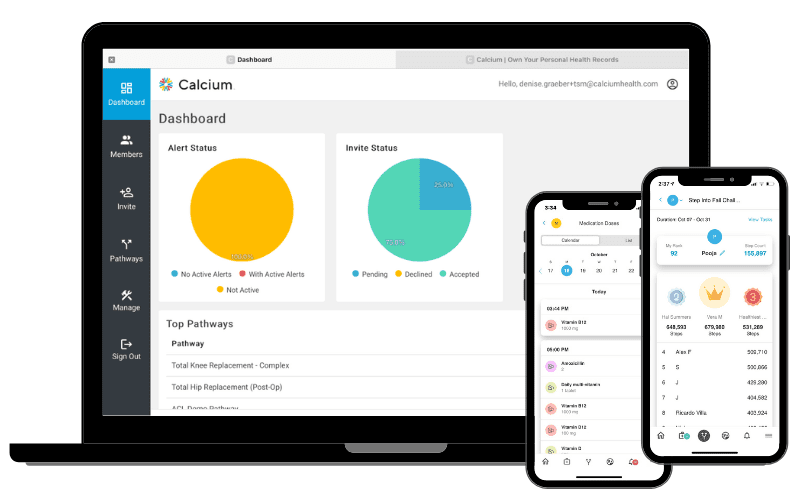
The Intelligence Platform for Membership-Based Medicine
Membership medicine is not a trend, it is a fundamental shift in how care is delivered, experienced, and sustained.
Calcium is the digital infrastructure and intelligence layer that enables membership-based practices to deliver continuous, proactive, relationship-driven care at scale without losing what makes their model different.
Membership medicine requires more than access. It requires intelligence.
Built for Every Membership Medicine Care Model
Membership medicine is not one-size-fits-all. Each care model has distinct pressures, workflows, and expectations. Calcium provides a shared intelligence foundation that adapts to each segment’s philosophy supporting diverse membership practices without forcing them into rigid, generic technology frameworks.
Concierge Care
Calcium enables white-glove concierge care at scale by unifying patient intelligence, surfacing proactive insights, and making continuous care visible without increasing physician work.
DPC
Calcium provides Direct Primary Care practices with an intelligence backbone that organizes longitudinal data, structures asynchronous care, and protects simplicity as patient panels grow
Functional Med
Calcium synthesizes complex labs, symptoms, and lifestyle data into longitudinal insight, helping functional medicine clinicians recognize patterns, track progress, and guide personalized care over time.
Lifestyle Medicine
Calcium operationalizes lifestyle medicine through digital pathways, wearable integration and shared dashboards that support sustained behavior change, accountability & measurable outcomes across teams.
Integrative Health
Calcium unifies conventional care, advanced diagnostics, and patient narratives into a single longitudinal view, supporting coordinated integrative care and clearer insight across whole-person treatment plans.
Executive Med
Calcium delivers executive-ready health intelligence, transforming complex data into clear priorities, proactive risk signals, and concise summaries that support confident, time-efficient health decisions.
Personalized Med
Calcium supports personalized medicine by unifying longitudinal data, tracking individual responses, and surfacing meaningful patterns enabling truly tailored care plans that evolve with each patient over time.
Employee Health
Calcium enables employee health programs with longitudinal insight, proactive monitoring, and digital pathways that support prevention, engagement, and measurable outcomes across diverse workforces.
Membership Medicine Is a Care Philosophy, Not a Specialty
Membership medicine is often described as a collection of niches concierge care, DPC, functional medicine, lifestyle medicine, executive health. In reality, these are variations of a shared philosophy.
What unites membership-based practices is not patient demographics or pricing models, but how care is conceptualized and delivered.
Membership medicine practices share common principles:
- Care is longitudinal, cumulative, and relationship-based
- Value is created continuously, not only during visits
- Data gains meaning over time, not in isolated snapshots
- Engagement, accountability, and prevention are central
- The patient relationship is owned not mediated by payers
This philosophy places enormous demands on clinical insight, coordination, and continuity. It also exposes the limitations of traditional healthcare technology, which was never designed to support this way of practicing medicine.
Why Membership Medicine Is Reshaping Healthcare
At its core, membership medicine prioritizes:

Long-term relationships over episodic encounters

Preventive and proactive care over reactive treatment

Continuity, trust and engagement over volume & throughput

Retention and outcomes over transactional reimbursement
The Hidden (and Not-so-Hidden) Challenges of Relationship-Based Healthcare
Membership medicine shifts care upstream—but it also introduces pressures traditional systems were never designed to handle. These challenges surface quietly, shaping experience, sustainability, and growth long before they become obvious or urgent.

Scaling Membership Care Without Losing Personalization
As membership panels grow, practices struggle to preserve the individualized care patients expect. Manual workflows slow responsiveness, data fragments across tools, and subtle trends are missed.
Without intelligent infrastructure, growth quietly erodes the very personalization that defines membership medicine, weakens patient trust, and makes sustainable expansion increasingly difficult for clinicians and care teams.

Making Invisible Between-Visit Care Visible to Patients
Much of membership medicine happens outside scheduled appointments—monitoring trends, coordinating care, and preventing issues early. When this work remains invisible, patients question what their membership delivers.
Practices face growing pressure to clearly demonstrate ongoing value, reinforce trust, and help patients understand how continuous care extends far beyond the visit itself.

Transforming Longitudinal Data Into Clinical Clarity
Membership medicine generates continuous data from labs, wearables, messages, and patient narratives. Without synthesis, clinicians face information overload, miss early signals, and lose longitudinal perspective.
What should enable proactive care instead becomes noise, increasing cognitive burden and making it harder to identify meaningful trends that guide better, earlier clinical decisions.

Coordinating Team-Based Care Without Fragmentation
Membership practices increasingly rely on multidisciplinary teams, yet shared context is often missing. Without unified visibility, coordination breaks down, follow-up varies, and patients experience inconsistency.
Practices are forced to rely on memory and manual communication, undermining collaboration and making it difficult to deliver seamless, relationship-based care across physicians, coaches, and specialists.

Preventing Clinician Burnout in High-Touch Care Models
High-touch membership care places sustained mental strain on clinicians. Constant prioritization, interpretation of complex data, and near-continuous availability drive fatigue and burnout—even with smaller patient panels.
Without support, cognitive overload threatens clinical judgment, physician satisfaction, and the long-term sustainability of membership practices built on trust and continuity.

Proving Ongoing Membership Value to Protect Retention
Membership medicine depends on retention, yet many practices struggle to show tangible progress over time. When preventive impact and ongoing care value are unclear, patients question fees, disengage, or churn.
Demonstrating visible progress and proactive care is essential to maintaining trust, loyalty, and the financial stability of relationship-based care models.
What Membership Practices Gain With the Right Platform
When technology aligns with membership care principles, practices unlock new levels of insight, efficiency, and patient trust. These benefits show how Calcium supports daily operations while reinforcing the long-term value that membership medicine promises to both clinicians and patients.

Preserved Personalization at Scale
Membership medicine is defined by personalization—but growth puts that promise at risk. Calcium enables practices to scale patient panels without sacrificing individualized care by embedding intelligence into everyday workflows.
Instead of relying on memory, manual tracking, or inbox heroics, clinicians see a unified, longitudinal picture of each patient automatically.
Example: A growing concierge or DPC practice uses Calcium to maintain personalized follow-ups and insights even as panel size increases, without adding staff.
Experience how personalization scales without dilution—start a free 30-day trial of the Calcium platform.

Continuous Care Made Visible to Patients
Much of the real value in membership medicine happens between visits, yet patients often struggle to see it. Calcium makes continuous care tangible by translating behind-the-scenes monitoring, trend analysis, and coordination into clear, patient-friendly summaries and progress narratives.
This transparency strengthens trust and reinforces why membership care is fundamentally different from episodic medicine.
Example: A functional or lifestyle medicine practice shares ongoing progress dashboards that show patients how trends are improving over time, even without frequent appointments.
Make your continuous care visible and valued—begin a free 30-day trial of Calcium today.

Longitudinal Clarity Instead of Data Overload
Membership practices collect enormous amounts of data over time, but volume without synthesis leads to overload. Calcium transforms fragmented labs, wearables, notes, and patient inputs into coherent longitudinal insight.
Clinicians see what’s changing, what matters now, and what requires attention—without sifting through raw data or disconnected dashboards.
Example: An integrative medicine clinician quickly identifies subtle trend shifts across labs and symptoms that would have been missed in isolated reports.
Turn overwhelming data into actionable clarity—try Calcium free for 30 days.

Proactive Care that Anticipates Risk
Reactive care undermines the promise of membership medicine. Calcium enables proactive, preventive care by continuously monitoring longitudinal data and surfacing early-warning signals before symptoms escalate.
This allows practices to intervene sooner, personalize care plans, and deliver on prevention as a daily operational reality—not a long-term aspiration.
Example: An executive health practice receives early alerts on cardiometabolic trends, allowing intervention months before a clinical threshold is crossed.
Move from reactive to proactive care—start your free 30-day Calcium trial.

Reduced Cognitive Burden for Clinicians
High-touch membership care can quietly exhaust clinicians. Calcium reduces cognitive load by synthesizing information, prioritizing signals, and generating high-signal summaries that eliminate constant chart reconstruction.
Clinicians spend less time processing data and more time applying judgment, building relationships, and practicing medicine sustainably.
Example: A DPC physician prepares for patient reviews in minutes instead of hours using AI-generated summaries.
Protect clinician focus and sustainability—experience Calcium with a free 30-day trial.

Consistent Care Across Multidisciplinary Teams
Membership medicine increasingly depends on team-based care, yet coordination often breaks down without shared context.
Calcium provides a unified intelligence layer so physicians, coaches, nurses, and specialists operate from the same longitudinal patient narrative. This consistency improves follow-through, reduces gaps, and delivers a seamless patient experience.
Example: A lifestyle medicine program aligns physicians and health coaches around shared dashboards showing adherence and progress trends.
Enable truly coordinated team-based care—start a free 30-day Calcium trial.

Operational Leverage without Bureaucracy
Lean membership practices need leverage, not layers of administration. Calcium provides operational efficiency through structured digital pathways, automated follow-ups, and intelligent summaries—without introducing rigid workflows or enterprise complexity.
Practices scale capability and consistency while preserving autonomy and flexibility.
Example: A solo physician uses digital pathways to automate routine check-ins, freeing time for complex patient needs.
Gain leverage without bureaucracy—try Calcium free for 30 days.

Stronger Retention Thru Tangible Membership Value
Retention is the lifeblood of membership medicine. Calcium strengthens retention by making progress, prevention, and proactive care visible and understandable to patients.
When members clearly see how their health is being actively managed, loyalty increases and pricing integrity is reinforced.
Example: A concierge practice reduces churn by sharing ongoing health narratives that demonstrate value beyond appointments.
Reinforce retention with visible value—start a free 30-day Calcium trial.

A Future-Proof Foundation for Membership Care
Membership medicine continues to evolve—new services, hybrid models, and expanding care teams introduce complexity.
Calcium provides a future-proof intelligence foundation that adapts as practices grow, diversify, and innovate, without requiring constant retooling or system replacement.
Example: A practice expands from concierge care into executive and lifestyle programs while maintaining one unified care platform.
Build on infrastructure that grows with you—experience Calcium free for 30 days.
What Membership Practices Gain with the Calcium Digital Health Platform
Across models, membership practices gain the same strategic advantages:
- Clearer longitudinal insight across all data sources
- Reduced physician cognitive and operational burden
- More proactive, preventive care delivery
- Stronger patient engagement and retention
- Tangible demonstration of membership value
- Scalable growth without experience dilution
Calcium strengthens the attributes that make membership medicine viable rather than quietly undermining them.
FAQ
1. What is membership medicine?
Membership medicine is a healthcare model in which patients pay a recurring fee for ongoing, relationship-based care rather than paying per visit or relying primarily on insurance reimbursement. The model emphasizes continuity, prevention, access, and long-term health outcomes. Care is designed to extend beyond appointments, incorporating proactive monitoring, longitudinal insight, and ongoing communication. Membership medicine allows clinicians to focus on patient relationships and outcomes instead of volume and billing complexity. Concierge medicine, Direct Primary Care (DPC), functional medicine, lifestyle medicine, and executive health are all expressions of this broader membership-based approach to care delivery.
2. How is membership medicine different from traditional healthcare?
Traditional healthcare systems are structured around episodic visits, billing codes, and transactional reimbursement. In contrast, membership medicine prioritizes long-term relationships, continuity, and proactive care. Value is delivered continuously rather than only during scheduled appointments. Patients expect clarity, responsiveness, and prevention, while clinicians aim to manage health over time instead of reacting to acute issues. This shift fundamentally changes operational needs, data requirements, and patient expectations—making traditional healthcare technology poorly suited for membership-based care models.
3. Is concierge medicine the same as membership medicine?
Concierge medicine is one form of membership medicine, but it is not the only one. Membership medicine is an umbrella category that includes concierge care, Direct Primary Care (DPC), functional and integrative medicine, lifestyle medicine, executive health, personalized medicine, and hybrid or virtual membership models. While each segment serves different populations and care philosophies, they share core principles: longitudinal relationships, proactive care, and a subscription-based structure. Calcium is designed to support all of these models through a shared intelligence foundation rather than segment-specific tools.
4. Why do membership medicine practices need different technology?
Most healthcare technology is designed to support billing, documentation, and episodic encounters. Membership medicine operates differently. It requires tools that can aggregate longitudinal data, support between-visit care, reduce cognitive burden, and make continuous care visible to patients. Without technology built for these needs, practices rely on manual workflows, fragmented tools, and clinician memory—limiting scalability and sustainability. Membership medicine requires an intelligence layer that supports continuity, prevention, and relationship-based care rather than transactional workflows.
5. What are the biggest challenges facing membership medicine practices today?
As membership practices grow, they face structural challenges that are not clinical in nature. These include scaling patient panels without losing personalization, managing growing volumes of longitudinal data, coordinating multidisciplinary teams, reducing clinician burnout, and clearly demonstrating ongoing membership value. Many practices also struggle to make between-visit care visible to patients and to shift reliably from reactive to proactive care. These challenges emerge naturally as practices succeed and mature, highlighting the need for infrastructure designed specifically for membership-based care.
6. How does Calcium support membership medicine practices?
Calcium provides a unified health intelligence platform designed specifically for membership medicine. It aggregates data from clinical records, labs, wearables, patient-reported inputs, and care pathways into a single longitudinal narrative. Calcium synthesizes this information into high-signal insight, surfaces proactive risk trends, and supports between-visit care. Rather than replacing existing systems, Calcium sits above them as an intelligence layer—reducing cognitive burden, improving coordination, and making continuous care visible to patients and care teams.
7. Is Calcium an EHR or a patient portal?
No. Calcium is not an electronic health record (EHR) replacement or a traditional patient portal. EHRs are designed primarily for documentation, compliance, and billing, while portals focus on access and messaging. Calcium serves a different role. It functions as an intelligence layer that synthesizes data across systems, surfaces trends, and supports proactive care between visits. Calcium complements existing tools by providing clarity, prioritization, and longitudinal insight rather than duplicating documentation or messaging functionality.
8. How does Calcium help reduce clinician burnout?
Membership medicine can be mentally demanding due to constant availability, long-term responsibility, and growing data complexity. Calcium reduces burnout by synthesizing information, prioritizing signals, and generating executive-level summaries that eliminate the need for manual chart reconstruction. Clinicians spend less time sorting data and more time applying judgment and building relationships. By reducing cognitive overload and low-signal work, Calcium supports sustainable practice models while protecting clinical focus, satisfaction, and long-term career longevity.
9. Can Calcium help practices scale patient panels?
Yes. Calcium enables responsible growth by preserving personalization through intelligence rather than manual effort. As patient panels expand, Calcium maintains longitudinal visibility, proactive monitoring, and structured follow-up without increasing staff burden. This allows practices to grow without diluting experience or relying on clinician heroics. Scaling becomes a function of insight and infrastructure, not memory and manual workflows—protecting both care quality and patient trust.
10. How does Calcium make between-visit care visible to patients?
Much of membership care happens quietly between visits, which can make value difficult for patients to perceive. Calcium translates this continuous work into clear, patient-friendly summaries, dashboards, alerts, and progress narratives. Patients can see how their health is being monitored, how trends are evolving, and what actions are being taken proactively. This visibility reinforces trust, strengthens engagement, and helps patients understand why membership-based care is fundamentally different from episodic medicine.
11. Does Calcium support preventive and proactive care?
Yes. Calcium is designed to make preventive care operational. By continuously monitoring longitudinal health data, the platform surfaces subtle trend deviations, early-warning signals, and emerging risk patterns. This allows clinicians to intervene earlier, adjust care plans proactively, and prevent escalation before symptoms become diagnoses. Prevention becomes a reliable, repeatable process rather than an aspirational goal, strengthening the long-term value of membership-based care.
12. How long does it take to implement Calcium for perioperative medicine?
13. Which membership medicine models can use Calcium?
Calcium supports a wide range of membership-based care models, including concierge medicine, Direct Primary Care (DPC), functional and integrative medicine, lifestyle medicine, executive health, personalized medicine, and employee health programs. The platform adapts to different workflows and philosophies while maintaining a shared intelligence foundation. This allows practices to evolve, expand services, or add new care models without re-architecting their technology stack.
14. Can Calcium be used by small or solo membership practices?
Yes. Calcium is designed to support solo clinicians and small teams as effectively as larger practices. By reducing manual work, synthesizing data, and providing operational leverage, Calcium helps small practices deliver high-touch care without adding administrative complexity. Solo and lean teams gain the benefits of intelligence and structure without needing additional staff or enterprise infrastructure.
15. How does Calcium help justify membership fees?
Membership practices rely on patients clearly understanding the value they receive over time. Calcium helps justify membership fees by making progress, prevention, and proactive care visible and understandable. Longitudinal summaries, trend insights, and care narratives demonstrate ongoing value beyond office visits. This transparency strengthens trust, supports retention, and reinforces pricing integrity in membership-based models.
16. Does Calcium integrate with wearables and remote monitoring tools?
Yes. Calcium integrates data from wearables, remote monitoring devices, and patient-generated sources. Importantly, it does not simply display raw metrics. Instead, Calcium synthesizes this data into clinical insight, helping clinicians identify meaningful trends and prioritize action. This approach reduces noise and supports proactive decision-making rather than overwhelming clinicians or patients with dashboards.
17. Is Calcium HIPAA compliant?
Yes. Calcium follows HIPAA-compliant data handling practices and uses enterprise-grade security to protect patient information. The platform is designed to balance privacy with appropriate access, enabling care teams and patients to engage with health intelligence safely and responsibly. Security and compliance are foundational, not add-ons.
18. How long does it take to see value from Calcium?
Many membership practices begin seeing meaningful value within the first 30 days. This often includes improved longitudinal insight, reduced preparation time for visits, clearer prioritization, or better visibility into between-visit care. Because Calcium complements existing systems rather than replacing them, practices can experience benefits quickly without major workflow disruption.
19. Can Calcium evolve as a membership practice grows or changes models?
Yes. Calcium is built as a future-proof intelligence layer that adapts as practices grow, add providers, expand services, or adopt new membership models. Whether a practice evolves from concierge care into executive health, adds lifestyle programs, or introduces virtual memberships, Calcium supports change without requiring system replacement or structural redesign.
20. What is the best digital health platform for membership medicine?
The best digital health platform for membership medicine is one that supports continuous, relationship-based care rather than episodic visits and billing workflows. Membership medicine requires longitudinal insight, proactive monitoring, and visibility into care that happens between appointments. A strong platform should unify patient data over time, reduce clinician cognitive burden, and help practices clearly demonstrate ongoing value to members. Unlike traditional systems built for documentation or claims, the right platform enables prevention, personalization, and scalability. Calcium was designed specifically to meet these requirements by serving as a health intelligence layer that complements existing tools while supporting how membership medicine actually works.
21. How is Calcium different from an EHR for membership medicine?
Electronic health records are designed primarily to document encounters, support compliance, and facilitate billing. While essential, EHRs are not built to synthesize longitudinal data or support continuous care between visits. Calcium does not replace an EHR. Instead, it sits above existing systems as an intelligence layer that aggregates data from multiple sources, identifies trends, and surfaces actionable insight. For membership medicine practices, this means less chart-diving, clearer longitudinal understanding, and better proactive care. Calcium focuses on insight, prevention, and continuity—capabilities that traditional EHRs were never designed to deliver.
22. How does Calcium help justify concierge membership fees?
Concierge and membership practices depend on patients understanding the value they receive beyond access and visit time. Calcium helps justify membership fees by making continuous care visible and tangible. Through longitudinal summaries, progress narratives, alerts, and proactive insights, patients can clearly see how their health is being actively managed between visits. This transparency reinforces trust and helps patients appreciate the depth of monitoring, coordination, and prevention they receive. When ongoing care is visible and understandable, membership fees feel justified as an investment in continuous health stewardship rather than payment for appointments alone.
23. Is Calcium designed specifically for membership medicine practices?
Yes. Calcium is purpose-built for membership-based care models, including concierge medicine, Direct Primary Care (DPC), functional and integrative medicine, lifestyle medicine, executive health, and personalized care. Its architecture, workflows, and intelligence capabilities are designed to support continuity, prevention, and long-term relationships. Unlike platforms adapted from fee-for-service environments, Calcium assumes care happens between visits and over time. This design philosophy allows practices to scale responsibly, reduce cognitive burden, and preserve personalization—core requirements of membership medicine that generic healthcare technology often undermines.
24. How quickly can membership medicine practices see value from Calcium?
Most membership medicine practices begin seeing meaningful value from Calcium within the first 30 days. Early benefits often include clearer longitudinal insight for real patients, reduced preparation time for visits, and better visibility into between-visit care. Because Calcium complements existing systems rather than replacing them, practices can adopt it incrementally without major workflow disruption. Many clinicians report faster decision-making and improved confidence simply by having a unified, synthesized view of patient health. Value compounds over time as longitudinal data accumulates and proactive care workflows mature.
25. Does Calcium work with wearable devices and remote monitoring tools?
Yes. Calcium integrates data from wearable devices, remote monitoring tools, and patient-generated sources. Importantly, it does not simply present raw metrics or dashboards. Calcium synthesizes this data alongside clinical records and patient narratives to surface meaningful trends and early signals. This approach reduces noise and helps clinicians focus on what matters most. For membership medicine practices, wearable data becomes a source of proactive insight rather than an additional burden, supporting prevention, personalization, and continuous care without overwhelming clinicians or patients.
26. Is Calcium suitable for small membership medicine practices or solo physicians?
Yes. Calcium is designed to support solo physicians and small membership practices as effectively as larger organizations. Lean teams often face the greatest pressure to manage longitudinal data, proactive care, and high-touch relationships without additional staff. Calcium provides operational leverage by reducing manual work, synthesizing information, and supporting between-visit care. This allows small practices to deliver sophisticated, relationship-based care without adding complexity or administrative overhead. As practices grow, the platform scales with them rather than forcing early over-investment in infrastructure.
27. Does Calcium replace patient portals or messaging tools?
No. Calcium does not replace patient portals or messaging tools. Instead, it complements them by providing context, prioritization, and insight that traditional communication tools lack. Messaging platforms enable interaction, but they rarely help clinicians synthesize information or identify what requires attention. Calcium reduces message overload by supporting proactive workflows and clearer longitudinal understanding. Communication becomes more purposeful and informed, helping practices maintain responsiveness without increasing cognitive burden or fragmentation across tools.
28. How does Calcium support proactive and preventive membership healthcare?
Calcium is designed to make proactive and preventive care operational. By continuously monitoring longitudinal health data, the platform surfaces subtle trend deviations, early-warning signals, and emerging risks. This enables clinicians to intervene earlier, adjust care plans proactively, and prevent escalation before issues become symptomatic. For membership medicine practices, prevention becomes a repeatable process rather than an aspirational goal. Over time, this approach strengthens patient outcomes, reinforces trust, and delivers on the promise of relationship-based care.
29. Is Calcium HIPAA compliant?
Yes. Calcium follows HIPAA-compliant data handling practices and uses enterprise-grade security to protect patient information. Privacy, access control, and data protection are foundational to the platform’s design. Calcium balances compliance with usability, ensuring that care teams and patients can engage with health intelligence safely and responsibly. Security is built into the platform’s architecture, not added as an afterthought, supporting trust and confidence for membership medicine practices and their patients.
30. Can membership medicine practices share insights directly with patients using Calcium?
Yes. Calcium enables practices to share patient-friendly summaries, progress views, and health narratives directly with patients. These insights help patients understand their health trajectory, the reasoning behind care decisions, and the value of ongoing monitoring and prevention. Sharing insight—not raw data—strengthens engagement and trust while avoiding information overload. For membership medicine practices, this capability is essential for making continuous care visible and reinforcing the long-term value of the patient–clinician relationship.


Solution
Company
Blog
For Employers