
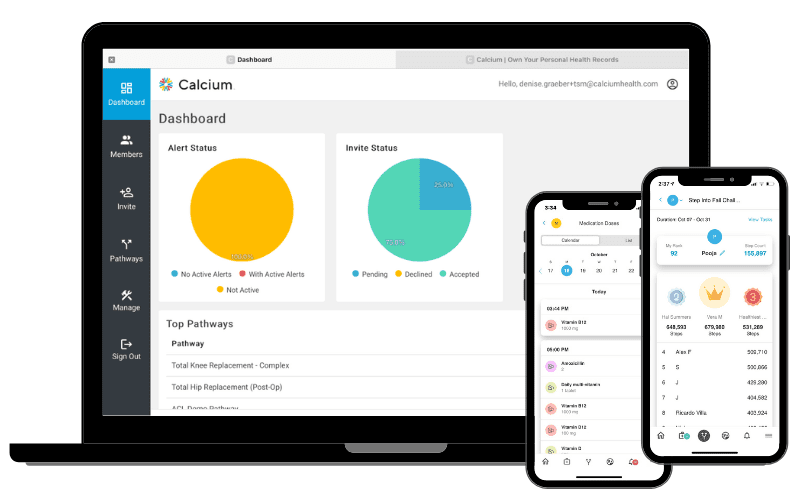
Perioperative Care Is Not a Moment, It’s an Episode
Surgical outcomes are shaped long before the procedure and long after discharge. Calcium gives perioperative teams continuous visibility and control across the full episode of care.
Perioperative Medicine, Reimagined: Digital Infrastructure for Surgical Readiness, Risk, and Recovery
Perioperative medicine has evolved.
What began as a consultative function focused on pre-operative clearance has become a systems-level discipline responsible for surgical readiness, risk mitigation, care coordination, and outcomes accountability across the entire surgical episode.
Yet while expectations have expanded, the digital tools supporting perioperative medicine have not.
Most perioperative teams are still forced to manage increasingly complex surgical populations using fragmented EHR data, manual workflows, and limited visibility beyond the hospital walls. The result is variability, late risk detection, preventable cancellations, and missed opportunities to improve outcomes at scale.
Calcium was built to change this.
Calcium enables perioperative medicine teams to standardize surgical readiness, identify risk earlier, and extend perioperative insight beyond discharge using pathway-driven workflows, unified patient data, and AI-powered intelligence designed specifically for modern surgical care.
The Evolving Role of Perioperative Medicine
Perioperative medicine is undergoing a fundamental shift. As surgical care becomes more complex, distributed, and outcomes driven, perioperative teams are being asked to play a broader, more strategic role across the surgical episode.
This evolution has expanded both the scope and the impact of perioperative medicine while exposing gaps between responsibility and infrastructure.
The Expanding Scope of Perioperative Medicine
Across hospitals and health systems, perioperative medicine has evolved well beyond pre operative clearance.
Today, perioperative teams are increasingly responsible for managing surgical readiness, stratifying risk across complex patient populations, and reducing day of surgery cancellations. Their work supports ERAS programs, standardized surgical pathways, and improved length of stay and post-operative outcomes, while also aligning surgical care with broader quality, safety, and value based initiatives.
As surgical volumes rise and patient complexity increases, perioperative medicine has become essential to delivering consistent, high quality surgical care.
Growing Accountability Without Supporting Infrastructure
As the role of perioperative medicine expands, so does its accountability. Perioperative teams now function as the clinical connective tissue between surgeons, anesthesia, nursing, care management, and operations coordinating care across disciplines and phases of the surgical episode.
Yet most perioperative programs are still operating with fragmented data, manual workflows, and limited visibility beyond the hospital walls.
Without digital infrastructure designed for longitudinal, episode based care, teams are expected to deliver system level impact using tools built for isolated encounters creating strain, variability, and missed opportunities for improvement.
Why Concierge Care Strains at Scale
These challenges are not the result of clinical oversight or lack of expertise they stem from infrastructure that was never designed to support longitudinal, episode based surgical care.

Fragmented Pre-Operative Data
Perioperative teams are responsible for assessing surgical risk, yet critical patient information is often scattered across disconnected systems.
Prior surgeries, chronic conditions, medications, and diagnostic data may reside outside the primary EHR or arrive late in the process.
As a result, clinicians spend valuable time assembling incomplete histories instead of managing risk proactively often uncovering issues too close to surgery to intervene effectively.
Common consequences include:
– Last-minute consults and clearance delays
– Day of surgery cancellations
– Elevated clinical and operational risk

Inconsistent Readiness Workflows
Pre-operative optimization is frequently handled through manual, variable processes that differ by surgeon, procedure, or site of care.
Protocols may exist as static documents or informal checklists, making it difficult to standardize best practices or track patient adherence.
Without consistent, digital workflows, readiness assessments remain subjective and labor-intensive, limiting scalability and reliability across perioperative programs.
This inconsistency leads to:
– Wide variability in surgical readiness
– Difficulty scaling proven optimization strategies
– Increased clinician and staff frustration

Limited Visibility Beyond the OR
Once surgery is complete, perioperative teams often lose insight into patient recovery. Complications typically surface only after escalation through emergency visits, readmissions, or urgent phone calls.
Without structured post-discharge monitoring or feedback loops, teams lack early signals that could inform intervention or improvement efforts leaving perioperative medicine reactive rather than proactive.
The result is:
– Delayed detection of post-operative issues
– Missed opportunities for early intervention
– No systematic learning to improve future readiness

Expanding Accountability
Perioperative medicine teams are increasingly held accountable for system-level outcomes, including length of stay, ICU utilization, readmissions, and surgical bundle performance. However, most organizations lack digital infrastructure designed to manage care across the full surgical episode.
Perioperative teams are expected to influence outcomes they cannot consistently see, measure, or coordinate creating a gap between responsibility and capability.
This gap results in:
– Limited ability to impact outcomes at scale
– Fragmented measurement and reporting
– Strain on perioperative programs without clear leverage
How the Calcium Digital Health Platform Transforms Perioperative Medicine with Digital Surgical Care Infrastructure
Perioperative medicine sits at the center of surgical safety, efficiency, and outcomes yet most perioperative programs are still supported by tools designed for isolated encounters rather than coordinated surgical episodes. As expectations grow around readiness, risk reduction, and post-operative performance, perioperative teams need technology that helps them operate proactively, consistently, and at scale.
Calcium was built to meet this need by providing a unified digital foundation that connects data, workflows, and teams across the surgical journey.

Earlier, More Complete Surgical Risk Assessment
Calcium gives perioperative teams a longitudinal view of surgical risk by unifying patient history, diagnoses, medications, and prior procedures across systems.
This allows risk to be identified earlier when intervention is still possible rather than days or hours before surgery.
Enables:
- More confident clearance decisions
- Fewer last-minute risk discoveries
Get started today with a 30-day free trial.

Standardized, But Flexible Surgical Readiness
Calcium replaces ad hoc checklists with configurable perioperative pathways that standardize optimization while preserving clinical judgment.
Teams can scale best practices across surgeons and sites without forcing one size fits all workflows.
Enables:
- Consistent readiness across procedures
- Scalable optimization programs
Get started today with a 30-day free trial.

Reduced Day of Surgery Cancelations & Delays
Real-time readiness monitoring highlights unresolved requirements early, allowing perioperative teams to intervene before surgery day.
This improves predictability and protects operating room utilization.
Enables:
- Earlier issue resolution
- Fewer preventable cancellations
Get started today with a 30-day free trial.

Improved Visibility into Post-Discharge Recovery
Calcium extends perioperative insight beyond discharge through structured recovery monitoring, giving teams early awareness of deviations and complications that would otherwise surface reactively.
Enables:
- Earlier detection of recovery issues
- Safer post-operative oversight
Get started today with a 30-day free trial.

Proactive Instead of Reactive Risk Management
AI-powered signals help perioperative clinicians prioritize attention toward higher-risk patients, enabling proactive intervention without increasing cognitive burden.
Enables:
- Smarter prioritization
- Earlier, safer intervention
Get started today with a 30-day free trial.

Reduced Manual Work for Perioperative Teams
Automated workflows reduce chart chasing, phone calls, and manual follow-ups, allowing clinicians to spend more time managing risk and less time managing logistics.
Enables:
- Lower administrative burden
- Improved staff efficiency
Get started today with a 30-day free trial.

Better Coordination Across Surgical Care Teams
Shared dashboards and role aware workflows align perioperative medicine with surgery, anesthesia, nursing, and care management across the full episode.
Enables:
- Fewer handoff failures
- Clearer accountability
Get started today with a 30-day free trial.

A Closed-Loop Feedback System
By connecting optimization efforts to recovery outcomes, Calcium allows perioperative teams to continuously refine readiness strategies using real-world data.
Enables:
- Continuous learning
- Evidence-driven optimization
Get started today with a 30-day free trial.

Stronger Support for ERAS & Quality Programs
Calcium operationalizes pathway adherence and outcome measurement, helping perioperative teams demonstrate impact on safety, quality, and value-based initiatives.
Enables:
- Measurable program impact
- Better reporting and insight
Get started today with a 30-day free trial.

Scalable Infrastructure for Practice Growth
Designed for pilot-to-enterprise adoption, Calcium scales across procedures, sites, and service lines without heavy IT lift or EHR rework.
Enables:
- Faster adoption
- Long-term sustainability
Get started today with a 30-day free trial.
Perioperative Initiatives Powered by a Unified Surgical Care Platform
Today’s perioperative teams are asked to influence outcomes that span far beyond pre-operative assessment touching efficiency, safety, recovery, and enterprise wide performance.
Meeting these expectations requires more than isolated tools or manual coordination. It demands a platform that can connect workflows, data, and teams across the full surgical episode.
Calcium was designed to serve as this foundation, enabling perioperative programs to operationalize priority initiatives, align stakeholders, and drive measurable improvement across surgical care.
ERAS & Clinical Pathways Programs
ERAS and clinical pathway programs aim to reduce variation and improve recovery, but many struggle to scale consistently across surgeons, procedures, and sites.
Calcium transforms ERAS from static guidance into executable digital workflows that span the surgical episode. Protocols are embedded directly into perioperative pathways, enabling consistent delivery, automatic adherence tracking, and outcome measurement.
By connecting pathway execution to recovery data, Calcium allows perioperative teams to refine protocols based on real-world performance, turning ERAS into a continuous improvement system rather than a compliance exercise.
Surgical Quality and Safety Programs
Perioperative quality and safety initiatives increasingly emphasize prevention rather than reaction, yet limited visibility often delays intervention.
Calcium supports proactive safety management by enabling earlier identification of risk and closer coordination across perioperative stakeholders. Unified data and real-time monitoring help teams surface issues sooner, while shared dashboards improve alignment across disciplines.
By linking workflows to outcomes, Calcium allows quality programs to move beyond isolated event review toward systematic, data-driven improvement across surgical care.
Value-Based and Bundled Care Programs
Bundled and value-based care models require perioperative teams to influence outcomes across the full surgical episode.
Calcium provides episode-level visibility that helps teams manage drivers of cost and quality more effectively. Coordinated pathways reduce variation, while early insight into readiness and recovery supports intervention before avoidable utilization occurs.
By aligning clinical workflows with utilization and outcome metrics, Calcium enables perioperative medicine to support financial accountability without compromising patient-centered care.
Pre-Op Optimization & Surgical Readiness Programs
Preoperative optimization programs improve outcomes but are often hindered by inconsistent execution and limited adherence tracking.
Calcium embeds optimization activities into structured perioperative pathways, giving patients clear guidance and teams real-time visibility into readiness. Longitudinal data aggregation helps identify optimization needs earlier, allowing meaningful intervention.
This transforms readiness from a last-minute assessment into a measurable, proactive program that improves preparedness and reduces cancellations
Surgical Throughput & OR Efficiency Initiatives
Operating room efficiency depends heavily on perioperative readiness, yet unresolved issues frequently surface too late.
Calcium improves throughput by making readiness transparent and actionable well before surgery day. Real-time dashboards highlight incomplete requirements, allowing early intervention and fewer last-minute disruptions.
By improving coordination across perioperative, surgical, and anesthesia teams, Calcium supports more reliable schedules, better OR utilization, and improved operational predictability.
High Risk Surgical Patient Management Programs
High-risk surgical patients require earlier identification and closer oversight, but traditional workflows often detect risk too late.
Calcium combines longitudinal patient data with intelligent risk signals to help perioperative teams identify complex patients earlier and assign appropriate pathways. Structured monitoring across the surgical episode supports timely intervention without overwhelming staff.
This enables safer planning and better outcomes for complex patients while improving resource allocation.
Post-Discharge Surveillance & Readmission Prevention
Many complications and readmissions emerge during early recovery, outside traditional perioperative visibility.
Calcium extends oversight beyond discharge through structured recovery monitoring aligned to surgical pathways. Early signals of deviation allow teams to intervene sooner, supporting safer transitions and reducing avoidable utilization.
This enables perioperative medicine to influence outcomes that were previously managed reactively.
Standardization & Variability Reduction Programs
Unwarranted variation across surgeons and sites undermines consistency and outcomes.
Calcium enables standardization through configurable perioperative pathways governed centrally while allowing appropriate clinical flexibility. By tracking execution and outcomes, organizations can identify and address sources of variation systematically.
This supports more reliable care delivery without imposing rigid protocols.
Multidisciplinary Care Coordination Programs
Calcium provides a shared orchestration layer that connects teams around a single surgical episode. Role-aware dashboards and structured workflows improve visibility, accountability, and handoffs.
This reduces friction, improves efficiency, and supports safer perioperative care.
Data-Driven Perioperative Performance Improvement
Sustained improvement requires timely, actionable insight, not retrospective reports.
Calcium connects perioperative workflows, patient data, and outcomes into a unified system that supports continuous learning. Teams can identify trends, evaluate interventions, and refine pathways based on real performance.
This turns perioperative improvement into an ongoing, data-driven practice rather than periodic review.
Measuring What Matters Across the Surgical Episode
Calcium provides perioperative teams with visibility across the full surgical episode, enabling performance to be assessed in ways that reflect real clinical and operational impact.
Clinical Metrics
These measures reflect the effectiveness of perioperative care in identifying risk, supporting patient safety, and influencing immediate surgical outcomes.
- Day-of-surgery cancellations
- Unplanned ICU admissions
- Post-operative complications
Operational Metrics
These indicators capture how efficiently perioperative workflows function across readiness, coordination, and day of surgery execution.
- Time to clearance
- Pre-op clinic throughput
- OR on-time starts
Strategic Metrics
These measures connect perioperative performance to broader organizational goals related to utilization, financial accountability, and long-term outcomes.
- Length of stay variability
- Readmissions
- Surgical bundle outcomes
Orchestrating Perioperative Workflows Across the Surgical Episode
Before Surgery
The pre-operative phase is where many downstream outcomes are determined.
Establishing a clear, comprehensive view of the patient and defining the right course of action early allows perioperative teams to intervene proactively, align stakeholders, and reduce uncertainty long before the day of surgery arrives.
- Patient data aggregated across systems
- Risk stratification performed
- Perioperative pathway assigned
Surgical Readiness
As surgery approaches, visibility and coordination become critical.
Perioperative medicine teams must be able to quickly identify outstanding issues, prioritize attention, and ensure that concerns are addressed through clear, timely action rather than last-minute decision-making.
- Real-time adherence and readiness monitoring
- Alerts for unresolved risks
- Coordinated escalation
After Surgery
The perioperative episode does not end when the procedure is complete.
Maintaining structured oversight during recovery enables teams to understand how patients are progressing, respond sooner when recovery deviates from expectations, and apply those insights to strengthen future perioperative care.
- Structured recovery monitoring
- Early warning signals detected
- Insights fed back into perioperative optimization
A Platform Designed for the Full Scope of Perioperative Care
Perioperative teams operate at the intersection of clinical decision-making, coordination, and outcomes accountability. To succeed at this level, they need technology that reflects the complexity and continuity of surgical care not isolated tools or limited point solutions.
Calcium was designed with these realities in mind, providing perioperative programs with a foundation that supports proactive management, consistent execution, and sustained improvement across the surgical episode. Perioperative teams choose Calcium because it is…
• Episode-based, not encounter-based
• System-agnostic, not EHR-locked
• Orchestration-focused, not tool-centric
• Actionable, not retrospective
• Scalable across sites and procedures
Calcium transforms perioperative medicine into a proactive, data-driven engine for surgical excellence.
Perioperative Medicine Insights
Enhancing Communication in Perioperative Teams with Digital Tools
The Importance of Communication in Perioperative Care Communication is the backbone of perioperative care. From preoperative planning to postoperative recovery, clear and efficient communication ensures that every team member is on the same page. Miscommunication can...
The Impact of Data Analytics on Perioperative Efficiency and Outcomes
Imagine you're about to embark on a long road trip. You wouldn't just hop in your car without a map, right? Similarly, preoperative planning is crucial for a successful surgical journey. Data analytics helps: Predict Surgical Risks: By analyzing patient history and...
Improving Pain Management with Digital Health Tools in Perioperative Care
Improving Pain Management with Digital Health Tools in Perioperative Care The Role of Digital Health Tools in Pain Management Monitor Pain Levels Wearable devices and mobile apps can continuously monitor a patient's pain levels. This real-time data allows for timely...
FAQ
1. What is Calcium’s Perioperative Medicine solution?
2. How does Calcium support perioperative medicine beyond pre-operative clearance?
3. How does Calcium help reduce day-of-surgery cancellations?
4. Can Calcium aggregate patient data from outside health systems?
5. How does Calcium support ERAS and perioperative pathway programs?
6. How does Calcium use AI in perioperative medicine?
7. Does Calcium support post-discharge monitoring for perioperative teams?
8. How does Calcium improve coordination between perioperative teams and surgeons?
9. Is Calcium designed for hospitals, ASCs, or both?
10. How does Calcium support value-based and bundled care initiatives?
11. What metrics can perioperative teams track with Calcium?
12. How long does it take to implement Calcium for perioperative medicine?
13. Does Calcium replace the EHR or existing perioperative tools?
14. How does Calcium help reduce manual work for perioperative staff?
15. Why choose Calcium over point solutions for perioperative medicine?
